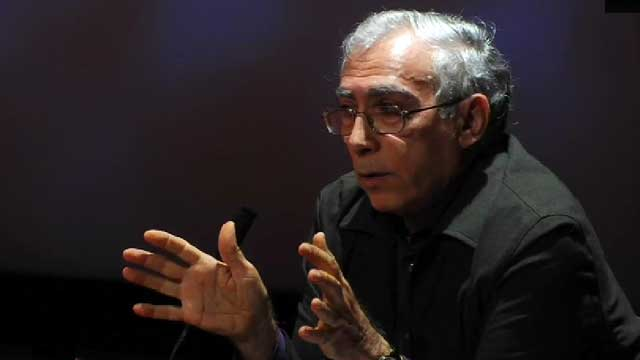
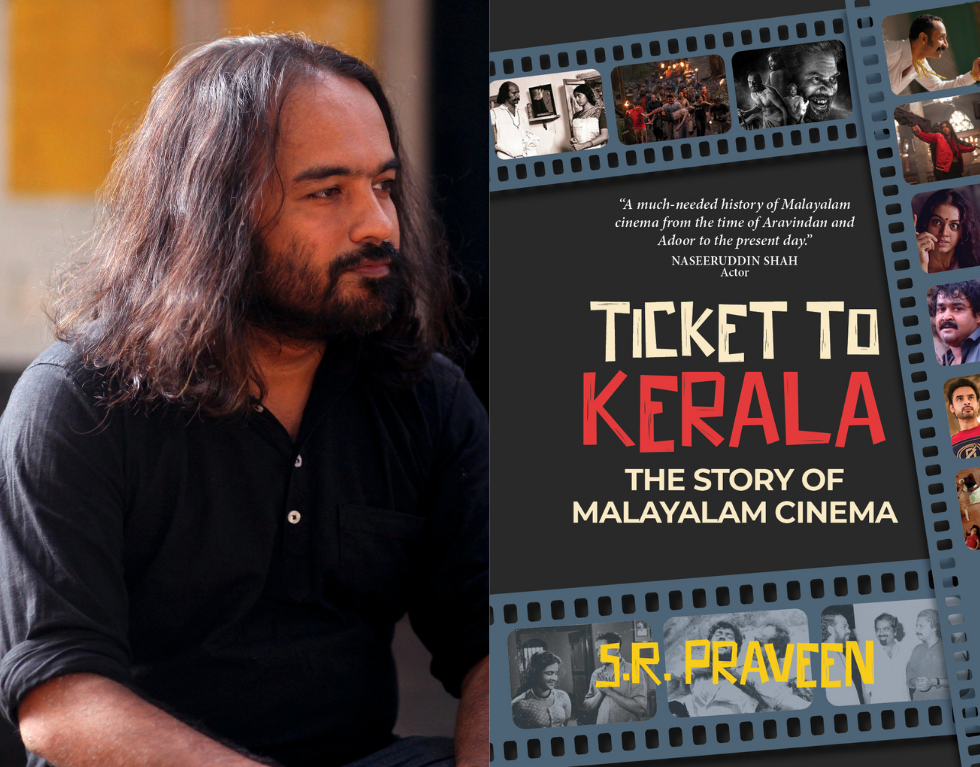
Our editor, Niveditha K Prasad was able to sit down with SR Praveen to discuss his debut book, Ticket to Kerala: The Story of Malayalam Cinema, published by Rupa Publications. A mechanical engineer-turned-journalist, SR Praveen has been a reporter and film critic with The Hindu in Kerala since 2012.We touched upon aspects of film criticism, the themes in the book, and the direction of Malayalam cinema. The below is an edited version of our conversation.
[NIVEDITHA]
The book very much relies on certain protagonists of Malayalam cinema, as you see them – it could be JC Daniel, KG George, Adoor Gopalkrishnan, Rajeev Ravi, to name just a few. You frame the book by narrating their encounters as consisting of the life of Malayalam cinema. I want to play around with that premise a little bit and ask: what is your encounter with cinema generally and with Malayalam cinema? How do you go from someone who likes films, enjoys films, to ultimately writing about them as a film critic and writing a book about the industry.
[SR PRAVEEN]
My introduction to cinema started – I think I’ve written in the book too – with my parents taking me to the theater as a small child. One of my earliest memories is of watching Ramji Rao Speaking. I think I was three or four years old when I watched it. Much of the films I consumed in my childhood was through Doordarshan. I did not have a cable TV connection at my home until I was in 9th or 10th standard, so on Saturdays and Sundays, Doordarshan was the major source of films. Then in 2001 or 2002, broadband came to India. BSNL started broadband internet and that was a turning point because suddenly I had access to this large variety of cinema from everywhere. Whatever films I came across in the newspapers, I used to go and search for torrents and download them. That was the time when I started watching cinema seriously. I’m not sure if you are familiar with Trivandrum, there’s a place called Beemappally. It used to have a very popular bootleg market, unlike the usual bootleg markets. The people there were very knowledgeable about world cinema. After the IFFK, they usually had most of the talked-about films. Whenever we go there, they would recommend, oh, this is the latest, this is the much talked about film in Venice, this one in Cannes.
That kind of culture spurred the curiosity for cinema. Then I started a column for films called Pick This Flick in my blog. Whatever films I liked, I used to write about them. By that time, I had started reading about cinema, whatever came in newspapers and magazines. I was a member of the British Library in Trivandrum. They had this British magazine called Film Review that used to carry a lot of articles on the latest films. All that helped to understand cinema, and maybe planted a thought in me to start writing about cinema. Then there was a very niche film website called passionforcinema in the mid-2000s which used to have long, nice pieces on Indian cinema. I did my engineering at that time and worked in the IT sector for three-and-a-half years but by the time I started studying engineering I realized that it is not something that I would like to pursue till the end of my life. After the IT stint, I started studying journalism at the Asian College of Journalism, moved to The Hindu, and somehow film reviewing came to me because I started showing that interest in culture and cinema. I am a regular reporter too but every Friday I turn into a reviewer. That has been life since 2012.
[NIVEDITHA]
I want to zoom in a little bit about the craft of writing reviews. You have spent more than a decade writing about Malayalam cinema for The Hindu. What is your process like? For instance, Pauline Kael of The New Yorker would never watch a movie twice because she said that the first time you watch a movie is the truest reaction that you can have to a movie. She would always write with a pencil, because she could only think with a pencil. Are there any specific writing or reviewing rituals that you have developed over the years to really allow your review to speak?
[SR PRAVEEN]
I do not take notes [laughs]. When the film happens, you just do not think about anything, you just enter the flow. The process has changed over the years because of the changes in journalism. When I started in 2012, the films used to release on Thursday or Friday and I needed to give the review only on Saturday evening for the Sunday paper. I had this whole day to sit and think about the movie. I could wake up the next day and start writing fresh by which time a lot of thoughts would have collected. But now in the last six to seven years, the whole process has changed. I am supposed to start writing the review by the time I am stepping out of the theatre. I think everyone else is now under that kind of pressure to put it out first, so I have some three hours after the movie to collect my thoughts and form a proper review. I usually watch the movie in the morning, have my lunch, and that is the time I start thinking about the points to write about. I start writing and then the points will evolve. I don’t have any specific rituals.
The immediate reactions and the reaction that you will get after a day are different. After some time, you start thinking about more aspects that did not strike you immediately. I would still prefer it if I get time to write one day after a movie as that makes a difference.
This change happened after YouTube reviews started coming in early. I think this is dictated by how Google searches work. We could see the difference: on the first day, if you put out a review of a movie, you’ll get like 50,000-60,000 hits, the next day you will struggle to reach 1,000. It is that kind of difference.
[NIVEDITHA]
This is probably a question for journalism as a whole, and for long-form journalism particularly. As a film reviewer, what is your solution to probably enjoy the writing process a little more, given the constraints imposed by the digital age. How do you cope with it? How do you reconcile your craft, your professional and creative inclinations with this other tendency to have everything out quickly.
[SR PRAVEEN]
To make it clear, I do still enjoy the current practice, it is just that I would have liked to have a little more time. Now I think I am used to this whole kind of pace. Whatever you said about enjoying the process and having more creative freedom – I think this book has somehow helped me do that. There was at least a six-month long process behind this book. It started with the publisher approaching me. What they wanted was a book about the new wave of Malayalam cinema post-2020 because that is what is being seen most outside Kerala.
I suggested that we should start by looking at the history of Malayalam industry, because without talking about what happened in the ‘70s or ‘80s, you cannot talk about the present of Malayalam cinema. I think that gave me the space to explore more about and even watch films that I have missed out over the years and revisit films I wanted to revisit but could not find the time. I also read a lot of literature on cinema that has come in Malayalam. Only when I started writing did I realize that we don’t have much about Malayalam cinema in English in the form of non-academic writing but in Malayalam, we have a wealth of writing. All this I could explore during this process for writing this. I think that somehow satiated that need for me to have a little more space and time to think and write.
[NIVEDITHA]
This is actually a good segue into the next question. As you mentioned, there is a wealth of literature on Indian cinema and on Malayalam cinema. You mentioned in the book too that Mammotty wrote a memoir. What were some of these books, music, or movies that may have inspired you or nourished you when writing the book?
[SR PRAVEEN]
Over the years, I have read books by critics such as Vijayakrishnan, VK Joseph, GP Ramachandran, CS Venketeswaran. In English, there is an interesting book on women in Malayalam cinema by Meena T Pillai which I read some time ago.
I started watching movies from the 1950s, movies I had always heard about, but never thought about watching. Maybe 10-15 years ago, it would have been difficult to get some of these films, but now a lot of it is available on YouTube, so I sat and watched them thanks to whoever thought of uploading them. Films like Rarichan Enna Pouran from 1956. If you watch that film, you will see the context in the state before the formation of Kerala, the situation of the oppressed classes, and the kind of anger that was present. It is a kind of a history lesson. You can see the political, social and historical context of the specific time in the movies from the 50s, 60s or 70s, even in the films which were not primarily meant to portray these. But you can just see it in the background. If the movie is set in Kochi or Trivandrum, you can see what Kochi or Trivandrum was like at that time. These are also historical artifacts. I enjoyed that process of watching all those films from the beginning to 2010 to 2020. I watched maybe 150 films in preparation for the book.
[NIVEDITHA]
A question that comes to my mind is, is there a difference when you watch movies as a regular enjoyer of films versus as a critique/someone who is writing a book on Malayalam cinema. Is there a more critical lens through which you watch it as a critic?
[SR PRAVEEN]
From the time I started writing about cinema in the blog, even before I joined The Hindu, I started viewing cinema a little more critically than just casually watching it. It is not like you play a Netflix film and walk around and do your tasks – that is different from sitting down and watching a film. Naturally, it becomes your instinct to watch out for certain things, how the screenplay is structured, how the characters are portrayed. That becomes normal to you in the habit of watching when you start writing about cinema.
[NIVEDITHA]
I was quite surprised by the shadow of the state in shaping up film sensibilities. For instance, Chitralekha was inaugurated by the then Kerala governor. Government school textbooks have a chapter on Bicycle Thieves. More recently, we saw the Hema committee, which was instituted by the Kerala government itself. These instances that you detail in the book are obviously very beneficial to the industry and to the art form itself, but do you not think that this is a double-edged sword? What happens when the sensibilities of those in power do not align with the conditions required for making good cinema.
[SR PRAVEEN]
One more major thing that you missed out is the funding of women and the SC/ST filmmakers that was launched by the previous government. When a government is funding a film, if the government is not intervening in the content of the film, then it is very much welcome. That is what has happened in Kerala. None of the filmmakers I have spoken to have complained that the government tried to intervene in their content. Their only complaints were about the administrators not providing funds at the right time and the bureaucratic hassles. Not one of them complained about not getting the creative freedom to do whatever they wanted.
Even IFFK is a state-funded initiative. There is certainly a political viewpoint that it has because all the competition films are from third world countries. It is progressive and socially committed. So long as things remain that way, we are happy that a festival like IFFK is happening. But when a government is in power and it has control over this festival and funding patterns and they start dictating that this festival or the people who are getting the funds should be making films in a particular way, that could be a problem. But that can happen even without the government directly funding or directly supporting the festival. If you look at Bollywood right now, you can see it is all corporate-funded cinema, but the films are talking the government’s language, with content that is desirable for the government.
[NIVEDITHA]
There is a very famous clip from a Satyajit Ray interview that routinely does the rounds on the internet where he talks about how he was attacked for making the film Devi. He says, we have a “fairly backward audience” in India. The Film Society movement in Kerala, as you describe it in Chapter 16 of your book, was very integral to building an audience that can appreciate films. There are teachers who are trying to screen the film in their classrooms, someone is trying to make subtitles in English and Malayalam for foreign films. I found these very inspiring. How do we reconcile this long history of film appreciation as a collective experience within film societies, film clubs, and classrooms with the rise in streaming these days, where spectatorship of cinema has very much become atomized.
[SR PRAVEEN]
Cinema is best enjoyed collectively. There is always a difference when you watch a film in a theater and when you enjoy it on an OTT platform. The difference can even be seen in the reaction to certain films when they release in the theaters, and when it comes to what OTT platform. When you are with a collective audience, your reactions play to each other. When you are sitting at home, you will be, I think, more critical. A lot of films which worked in theaters didn’t work for audiences sitting at home. There are even instances of huge backlash.
When it comes to film societies, I think most of them are struggling to get the kind of audience that they used to get in the past. But I think the instances that I mentioned, of someone creating Malayalam subtitles for world cinema, opened up cinema to a new section of audience for whom these things had remained inaccessible. Such creative efforts can still make film societies sustainable. There are women film societies happening in Kerala – there are two-three already or more – with women coming together and watching cinema. There is Banner Film Society in Trivandrum which has weekly film screenings, mostly of films that appeared in various festivals or some retrospective of some directors. That Film Society is getting an audience. I think film societies are still very relevant in that way, because people who miss out on certain films in film festivals still prefer to go to film societies.
[NIVEDITHA]
I now want to zoom in on certain specific aspects that you speak about in the book. I was intrigued by the Mohanlal-Mammotty phenomenon. You speak about how in the ‘80s, especially the year 1986 which was a very significant year in their lives, they were making both commercial films as well as films that lean towards more alternative films. But there was also a rise in hypermasculinity in Malayalam cinema in the 1990s. I would argue that this is something of a pan-India phenomenon, and there are many explanations that are offered for this. One is the liberalization reforms which fractured the role of Indian men in society. Then there was the rise of sectarianism which demanded a certain kind of masculinity from Indian men. Do you believe that these reasons also translate into explaining the rise of hyper masculinity in Malayalam cinema at that time period or do you offer some other additional or alternative reasons.
[SR PRAVEEN]
It was the product of its time – liberalisation and the rise of Hindutva. It was also a time when more women started working, driving scooters and became visible in the public sphere. It was also the time when the superstar fan clubs started. There was a need for a specific kind of cinema where there was an all-powerful hero being projected. Mohanlal and Mammotty were at the cusp of these events and so became the face of this kind of cinema. It is evident in films like Aaram Thampooram even though I enjoyed it. This trend was also dictated by the market.
But after five-six years, the currency of these films faded out. The rest of the factors like liberalisation still exists. Hindutva is at its height. But the market cannot sell these films because people’s tastes have changed. People began to see and question the political incorrectness of these films. Once in a while, a star may do a movie like that but there is no going back to that era. Its time has passed.
The kind of superstardom they achieved is also not possible in this era. Previously, we had limited entertainment choices. Now, even our attention is fractured which makes concentration impossible. These young stars are not doing that many films or with as much variety. They have their own course of plan that they follow, but whatever Mammotty and Mohanlal had was different. I do not think that is going to be replicated in the future.
[NIVEDITHA]
On a related note, you speak about Urvashi, Revathy, Shobana and how they were really able to elevate even very run-of-the-mill superstar vehicles in the 1980s and up to the early 1990s. Then you speak about Manju Warrier who had a spectacular four-year-run that she had before she quit films for some time. There seems to me a gap between these actresses, as well as the later crop of actresses whom you name – Parvati, Nazriya, Mamita Baiju, etc. I am curious about what the rise in this superstardom did to female characters, and how they are written and performed. You mentioned earlier how after the 1990s we actually saw women coming out into public spaces more often, but at the same time it seems to me that they were from the silver screen. Is this an accurate description?
[SR PRAVEEN]
A lot of portrayals of women characters were a reaction to women coming out, women becoming more active. If you look at a lot of the superstar movies, women were reduced to just being impressed by whatever the hero is doing or waiting to be saved by the hero. Most of them do not have any individuality of their own, except in rare cases, and were reduced to just being in the background as a pretty face. This is very different from what used to be in the 1970s and ‘80s when we had very, very strong women characters across a lot of films. Even with stars, they had their own space and their own character, with actors like Manju Warrier or Revathy. Revathy in Devasuram is a character who stands as strong as the male protagonist and even challenges him. Even Aaram Tampuram (in the late 1990s) had a very strong woman character in Manju Warrier, but if you look at films like Tandavam and films after that, those [films] do not have that kind of strong women characters. In the 2000s, we even had non-superstar films that did not have that kind of women character whom you can recollect now. All of this was probably a reaction to how women were becoming more liberated. This happened in the late ‘80s with feminist characters, for instance, Sukumari’s characters were always a caricature, never being seriously portrayed or being portrayed as a very negative character. That was a reaction to feminism from some of the male writers.
I think the situation has changed post-2010. But comparing them to the older actresses, they are getting memorable roles but not very powerful roles that can be compared to the roles that Revathy or Manju Warrier got. I think these roles are more suited to the kind of cinema that Malayalam cinema is making now. It is a different kind of cinema compared to whatever happened in the nineties and before.
[NIVEDITHA]
I want to ask about Malayalam cinema and its relationship to the other. In your book, you mentioned Balan (1938) borrowed from the Tamil movies of that time; Lijo Jose Pellissery used a lot of old Tamil music for creating an atmosphere in his movies. Sometime in the 2000s, there began what you describe as the “allure” towards Bangalore that reflects the realistic aspirations of Malayalis. Do you think that there is a cross-pollination of talents and influences between very fertile industries in the South to create something that is distinctive to this region? We talk about a pan-Indian film, but I am thinking about pan-South Indian cinema.
[SR PRAVEEN]
You can see more Tamil actors in Malayalam cinema, Malayalam actors in Tamil cinema, and in Telugu and Kannada. Some of it is at least due to commercial concentrations. In Jailer with Mohanlal and Shiva Rajkumar, you can see that they are clearly looking at the markets in Kerala and Karnataka. There is more synchronicity between these industries, people within these industries are talking to each other a lot more than in the past. In the past, there were friendships with Mohanlal and Mammotty. For example, Mammotty acted in Thalapathy. But now it is much more widespread, where even technicians and smaller actors are getting out to other industries.
I do not know if you can still call it a movement, but maybe we can wait and see if something evolves. But right now, what is happening is interesting. I wish that more technicians also crossover. Let us have musicians like Santosh Narayan doing more work in Malayalam, or even AR Rahman. Rahman has worked in Malayalam back in Yodha and after several years, he worked for Mahesh Narayan’s Malayankunju but that did not work out well. It will be interesting to see how the flavour of cinema will change when technicians are interchanged.
I’m not sure about whether there are writers who can be interchanged. I think writing needs to have some kind of grounding in that place and in the language. I do not know how effective it will be if Syam Pushkaran from Malayalam writes a Tamil film or Kannada film because much of the effectiveness of good writing comes from how rooted you are. Even now the Malayalam movies that are being talked about across India are very rooted in Kerala. For directors, it is more of a craft, so I think directors can move between industries. Recently, the director of Falimy (Nithish Sahadev) directed a film with Jiiva in Tamil (Thalaivar Thambi Thalaimaiyil). The same goes for musicians – we have Shreya Goshal singing in Malayalam films for so long.
[NIVEDITHA]
You chart a trajectory of Malayalam cinema that reaches its zenith in some ways in the 1980s and then proceeds to have somewhat of a decline before we arrive in the 2010s, when we begin to see films like Traffic, Bangalore Days, etc. I think it is very important for critics to make this kind of an analysis because they are both an insider and outsider to the industry. You have the intimacy of knowledge of cinema, but you also have a certain degree of objectivity as an outsider. From your position, therefore, what moment do you see Malayalam cinema currently inhabiting and what direction do you see it move forward?
[SR PRAVEEN]
It is in a very exciting phase right now. There is a lot of new talent popping up, especially a lot of new young directors. Last year had a huge number of debut filmmakers. But we have 200-250 films being produced in Malayalam and out of that only a handful are successful and being talked about outside Kerala. There is also this story about 200 films which are not becoming successful in the box office because the screenplays are very bad. There are projects that should not have been made because they are a torture to sit through.
But the general direction is positive. Young directors are pushing against repeating formulas even though business interests are pushing them towards it. I hope this momentum will sustain at least for the next 10 years. We also have a lot of interesting young writers. What happened in the late ‘90s and 2000s is that the legendary writers passed away or they stopped writing and then we did not have any fresh talent coming in. By the late 2010s we had new writers coming in who are now in their prime.
If you were stranded on a desert island, what would be the movie(s) that you would take with you?
Since we are talking exclusively about Malayalam films, I would limit my choices to Malayalam also. I would probably pick some KG George films like Panchavadi Palam and Irakal, also some of the great comedy movies of the 1980s like Mazha Peyyunnu Maddalam Kottunnu and Nadodikattu, and a few recent favourites like Kumbalangi Nights.
Movies that you return to frequently, especially when maybe you feel stuck
I never get tired of watching the Malayalam films of the 1980s and early 1990s. This is probably a bias which everyone holds, for they always prefer things they grew up watching in their childhoods.