How do you see the world if you don’t move through it? Perhaps, you see it as it moves while you remain still. In this essay, I move through three films which dwell on movement in direct and indirect ways – Jim Jarmusch’s anthology of three connected short films based in New Jersey, Dublin, Paris – Father Mother Sister Brother (2026), Koya Kamura’s French-Korean film Winter in Sokcho (2024), and the Indian filmmaker Achal Mishra’s documentary film Char Phool Hain Aur Duniya Hain (2025). The Mishra film invites us into an endless stillness while human relations are interpellated through movement in the other two. All three are quiet films. With divergent inner turbulences.
Adam Driver and Mayim Bialik are siblings who drive through snow-laden highways of New England to get to the remote cottage where their rather dysfunctional father (played by the legendary singer Tom Waits) lives, in the first Jarmusch film Father. The son has brought pasta and bourbon and cheese and cookies for the father in a cardboard box. He is anxious to see whether the wall for which he had paid earlier has actually been repaired. The daughter is calmer, stiffer, and less eager to bond with the father. The primary failure of love is writ large all across the wintry atmospheres of the film. They drive back in pity and guilt.
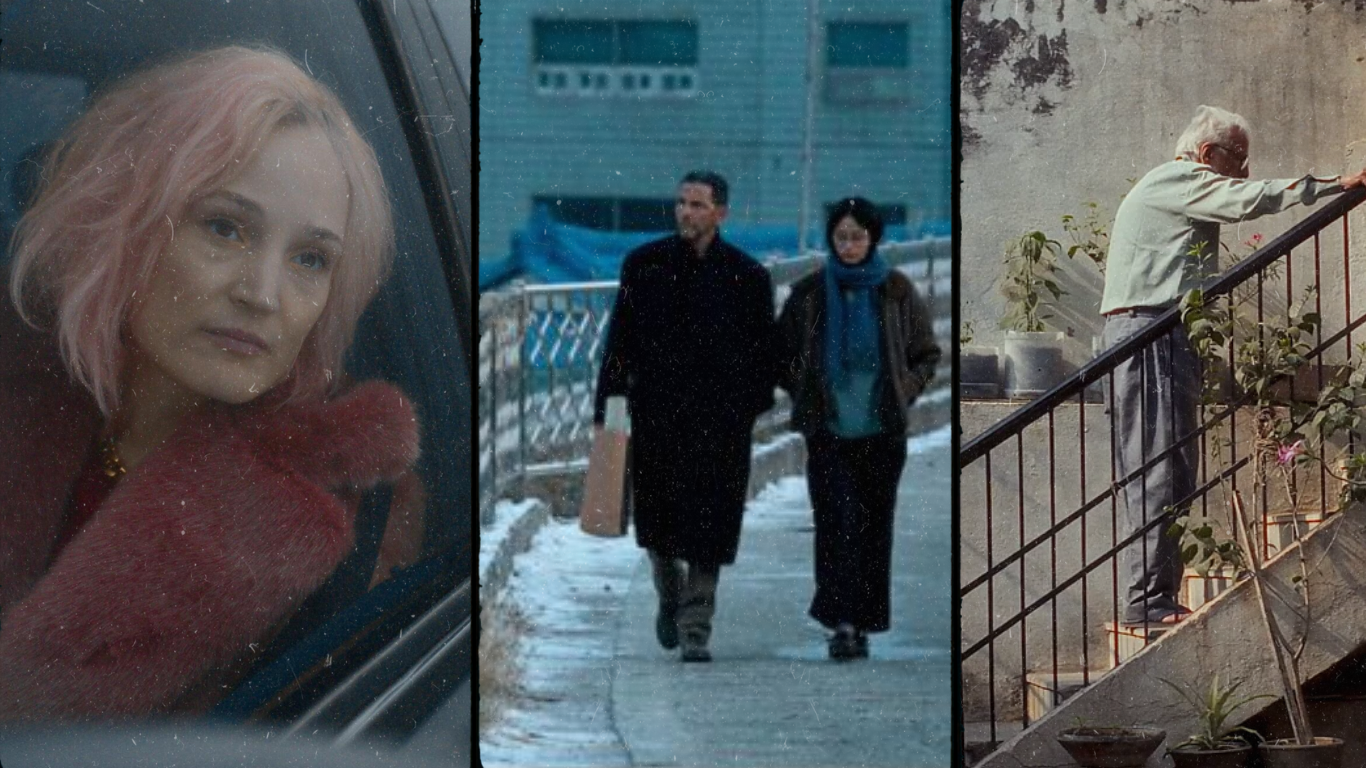
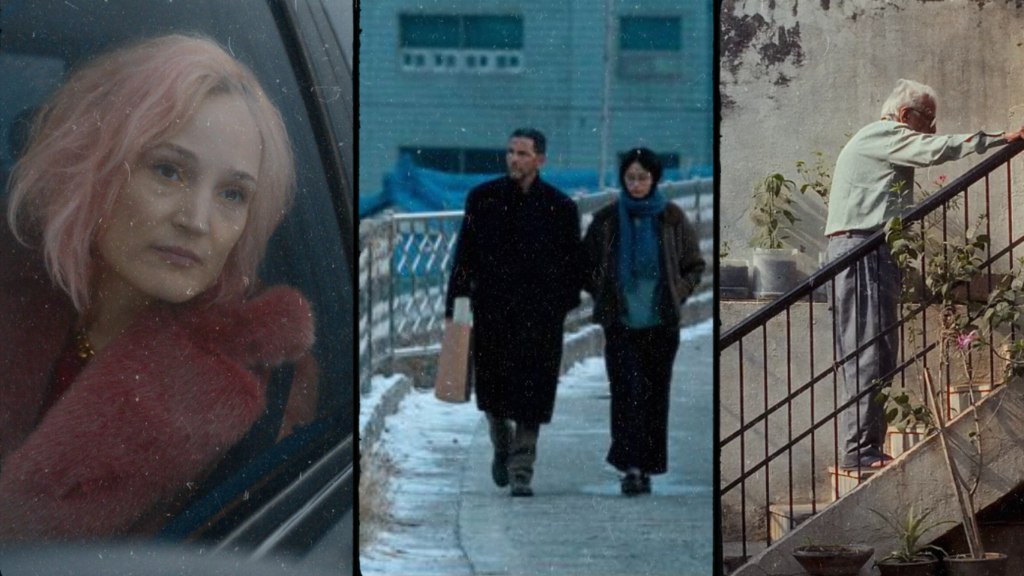
In the second Jarmusch film, Mother, a girlfriend is converted into an Uber driver when a lesbian woman with pink hair arrives at her mother’s impeccable Dublin house trying to please the otherwise disappointed mother with a story of the ‘rich and handsome’ boyfriend Robert who is keen to marry her. Cate Blanchett, the older daughter, is stiff, Irish, bespectacled, collared-shirted. Blanchett drives a beat-up old car that gives way on the road and picks up again. An office-woman for whom the yearly meeting with the mother over tea and cake is obviously a bit of an event. Both failure-daughters draw up in different cars to be looked upon in disappointment by the rather Type A, lonely, anxious mother. All three are wearing bright red sweaters. There is feverish discomfort across this annual teatime ritual. The failure to please a mother affects the daughters differently – one would like the mother to pay for her Uber, the other looks intently onto the mother while narrating her recent office promotion in the City Heritage Council.
In the first two films, there are stiff living rooms and there is tea. In the third film Sister Brother, there is coffee. Espresso in shot glasses at a Parisian cafe. A twin sister-brother unit pulls up in an old beat-up car that belonged to their recently deceased parents. The sister (played by Indya Moore) is brooding, charming, minimal, and gorgeous. The brother (played by Luka Sabbat) – dreadlocked, goofy, talkative, badass, bragging about his conquests with a ‘cute, indigenous girl’ – is less charming than the sister. They inhabit the empty Paris apartment where they had been raised by their mysterious, rebellious parents – a mixed-race couple who died in a sudden air-crash while flying their own aircraft. In this case too, there is an extreme form of movement and narrative that flows from it – death by movement. Their origins in Manhattan, their multiple US driving licenses, their fake marriage license, their hoarding habits, their general mysteriousness is noted in muted surprise by the twins. The meandering, dusty, beat-up car becomes a vehicle for mourning and union between the twins who now have separate adult lives. The well-lit Paris apartment is a symbol of conjugal, familial love. Where man and woman with loads of stuff and twin children had lived for decades. This is a love that is not doubted. It obviously makes me a bit acerbic. What is a clean, authentic love? It sounds almost like a Disney movie to me. Everyone drives slowly and evenly, without panic or anxiety, through their bumpy, tumultuous lives in these three short films.
In Koya Kamura’s film, a doomed but authentic love blooms between a South Korean girl of Sokcho (played by Bella Kim) and an older, brooding French artist (played by Roschdy Zem)as they go on a long road trip toward the borders between South and North Korea. The Frenchman shares a predictable taste for adventure and danger. The young woman, who is a student of French literature, and works at a bed and breakfast in this small town, harbours a strong intrigue for the nationality of her estranged father who, she is told, was French. She spends her time learning to perfectly cut octopus, and setting things in the rooms of the establishment. She watches him eat paper before he starts painting all through the night, through an upper ventilator gap in the wall of his room. They walk about and talk Korea and France. She tells him her story. He doesn’t quite tell her his. He is predictably restless, and she seems to catch the bug from him. Over the length of the film, he becomes detached and finally leaves one morning, leaving behind a portrait of her, and she becomes restless while outwardly still.
This stillness and the power to watch the world’s movement while remaining magically still, is the most enchanting aspect of Achal Mishra’s documentary film on the acclaimed Hindi writer Vinod Kumar Shukla. Manav Kaul, a theatre artist, is the interviewer in the film. The film dances around the nooks and crannies of the Shukla household. The writer’s son, who acts as an executive assistant of sorts to the aged (now gone) writer, speaks quite a bit. All speech in the film is still, including the more voluble interviewer. Everyone speaks slowly, in a measured way, in a very sweet Hindi of small-town north India. Shadows dance with the sun on the walls behind the seated persons. Flowerpots and tiny birds come into focus. The writer Vinod Kumar Shukla talks about his own lack of movement. He doesn’t go to too many places. He watches and speaks to the world and its inhabitants as they remain in movement. He experiences them as they experience the world in movement. In the beginning, he narrates getting a phone call from someone from Bihar who called him to check the veracity of the news that he was no longer alive. So, the person asked Shukla (in embarrassment) whether the writer Vinod Kumar Shukla was alive. He narrates anecdotes about going to Bombay, and meeting and developing a friendship with the auteur filmmaker Mani Kaul. He sits patiently sometimes on a chair, sometimes on a swing, sometimes by the window sill. He talks at length about his creative process, his son fondly corroborates details of his repeated drafts and reading sessions in the family.
The three films share in common their quietness. But the Jarmusch and Komura films share a quiet, tumultuous desperation. The characters are in unrest, restlessness, enacting an emphatic protest against the world. They demand a kind of recognition of their inner agony from the audience. In the Mishra film, light and shadow do the work of holding Shukla’s stillness, his patience, his measuredness. In the other films, cars and walking do a lot of work in holding motion-laden human intention. It demands that the audience descend into and share in its stillness. Jim Jarmusch’s film ends with the quiet yet very restless song by Nico, “These Days”.
I have been mourning the loss of the world as it was in the 1980s. The fashion, the wars, the shell-framed glasses, the bell bottoms, Tina Turner and Janet Jackson, wired telephones. All of it. I especially mourn the silence of physical worlds – the dance of shadows, the hushed telephone conversations, the sleepy afternoons of the summer, the winter picnics, the cutouts of sports celebrities on teenage walls. The three films brought back familiar sensations of quietness, ennui, muted longings, and the comfort of everyday disappointments papered over by cups of tea.
But we were not still. News of war and catastrophe used to reach us in glossy-covered magazines. Outlook and Frontline magazines were regularly read in our household. We knew the spelling of the names of statesmen and terrorists. We had the patience to read their names carefully, over and over, in shock and excitement. Bombay police encounters, international currency frauds, Kashmir and Kosovo danced in the theatrehouse of our imagination. To be still and to be silent are not the same things. Stillness offers a capacity to retain the world’s rhythms and not be induced into joining the tango. Stillness offers the powerful possibility of listening, witnessing. Mahayana Buddhism offers the vocabulary of a minimising of the self to a sense-registration device. If one is actually able to practice this, it would probably lead to stillness. For the rest of the world, there is silence, or the lack of noise, that carries the subtitle of peace (but is not really).
Mishra’s Chaar Phool presses against one’s senses. It forces a slow-down, a radical attention. It refuses the terrain of turbulence of biography. The Jarmusch and Komura films are portraitures of major or minor turbulences of the soul which manifest in the physical act of movement, even if silently. The anxieties of children to please their parents, the ambivalences and growing distances between siblings. In contrast, Vinod K Shukla seems at peace in a household full of birds and shadows, Mishra’s film lends an uncanny feeling of peace. In Mishra’s long-drawn gaze at the trembling shadow on a wall, I find that audiences of the internet can come somewhat close to understanding the interiority of a person like Vinod Kumar Shukla. A writer who sits completely still.