
Spring is a time of rejoicing. The cool winter winds become light breezes, the sun shines thicker, warmer, leaves turn green, flowers begin to blossom. Love suspends itself in the air like fine dust. In Indian films, poetry, and art, spring often represents the first flutters of love. One can feel those flutters in yearning, in waiting, in union, in separation. A garden full of flower buds, a heart full of possibilities. I seek to show how spring has been visualised as a narrative tool to show different stages of love–from yearning to the culmination of love. I draw parallels between film music and traditional ragamala paintings to depict how springtime can become a narrative force for the blossoming of love.
Spring in the Heart
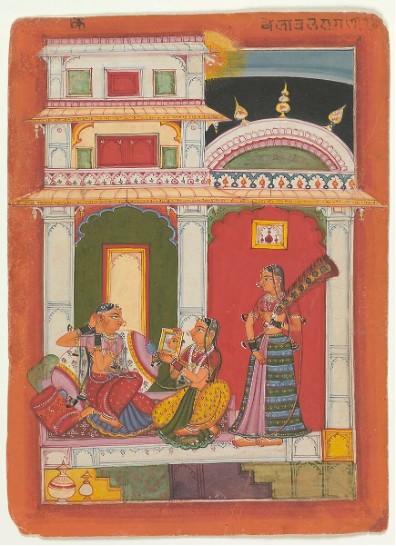
Vilaval Ragini: Folio from a ragamala series (Garland of Musical Modes, Met Museum)
Circa 1680. A dark sun rises in the sky. It is early morning. A group of ladies are adorning themselves. One holds up the mirror, the other watches on as the protagonist dresses herself, awaiting her lover. This is Ragini Bilawal, a raag for springtime yearning.
Ragamala is a genre of Indian miniature painting which picturises Hindustani raags based on the time of day, season and mood it is associated with. A ragamala painting at once achieves a multitude of possibilities. Through its composition it visualises a story. On the painting’s edges are scribbles of poetry, furthering the story with text. And finally through its colour scheme, it captures the season, the weather, the time of day, the mood of spring time. It is not unlike a music video; the lyrics of a dance song spell out a mood. The dance movements give that mood breath and finally, the camera captures it in all its splendour.
Here, the onset of spring brings the potential for union; love is on the cusp of blossoming.
Circa 2008. Jodha-Akbar releases with aplomb in the theatres. In the film, the song Jashn-e-Bahara, holds a testament to a love so bountiful that even spring rests in awe at it– kehne ko jashn-e-bahara hai, ishq yeh dekh ke hairan hai. However, this love is hidden in the hearts of those who carry it. Javed Ali’s lyrics describe this silent love through imagery–that of two rivers that never meet, that of flowers who refuse to spread their fragrance. In the song, we see Akbar watching Jodha from a distance, admiring her as she plays with rabbits and birds. They walk side by side and yet are not truly together. They sit with each other but with distance between them.
The imagery of a woman getting ready to meet her lover, the vasakasajja nayika, is a motif generously used in Indian art and poetry. This motif is replete with yearning. Here, like in the ragamala painting, Jodha bai prepares herself to meet Akbar. Her ladies in waiting perfume her hair, secure her anklets, and hold up a mirror for her to squarely dot a bindi on her forehead. While she readies herself, Ali sings “karte toh hai saath safar, faasle hai phir bhi magar, jaise milte nahi kisi dariya ke do kinare // we travel together and yet the distance between us is like the two shores of a river that never meet.” This moment, just like the 15th century painting, encapsulates the moment of yearning before one meets their lover. Both of their hearts are in the thick of spring and yet they do not confess.
Spring as Celebration
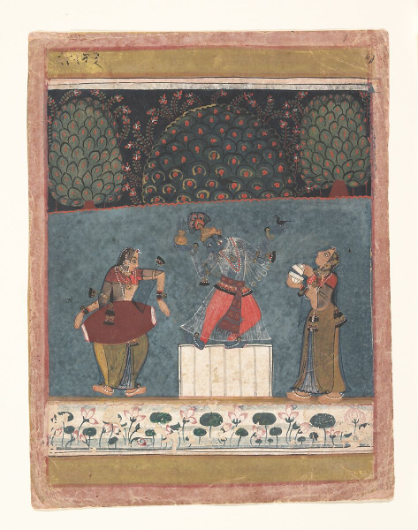
Vasant Ragini: Folio from a ragamala series (Garland of Musical Modes, Met Museum)
Circa 1640, Malwa. Krishna is flanked on either side by his gopis carrying drums and cymbals. His blueness spreads beyond his skin; encompassing all who stand in it. Blue, red, green and white, the colours of the beloved rasleela with Krishna.
In the month of March, the festival of Holi arrives. The winter blues diversify into pinks, greens, purples, yellows and reds. And the love that has begun to flutter, ignites into a love fully blossomed. Holi is the time for raasleela when Krishna and his lovers play, flirt, and tease each other.
Circa 2013, raas rachana, the act of playing, flirting and teasing one’s lover, takes on epic proportions in Goliyon Ki Rasleela, Ramleela, but perhaps finds its most sexy avatar in Lahu Munh Lag Gaya. Ram and Leela meet behind a large lamp, concealing the couple from the rest of the crowd. Leela catches Ram’s attention by applying vermillion on her cheek. Ram suggests that she apply it on her neck. She follows, stretching her head back to do so. His eyes stay transfixed on her hands. He then gives her his most intimate suggestion yet: he asks her to fill her forehead with vermillion, an act showing commitment to their love. He wipes off the red vermillion on his hands onto his lips, distracting Leela. She leans in, grabs him by the collar and kisses him.
Springtime teasing takes on a delectable form as the two play garba. One dances, the other follows. The choice of using garba here is calculated. Apart from the fact that this movie is set in Gujarat, garba as a dance style offers opportunities to build flirtatious, sensual tension. As the two concentric circles weave around each other, Ram and Leela both lose each other in the dance and find one another again—locking eyes, frequently enough for the heart to skip a beat, but not frequently enough to satisfy tensions.
Spring as Separation
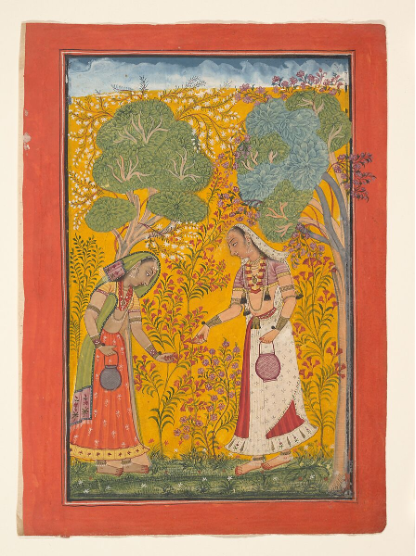
Vasanti Ragini, Page from a Ragamala Series (Garland of Musical Modes, Met Museum)
Circa 1670, a painting of two women picking flowers from a sea of yellow emerged in Bilaspur Himachal Pradesh. The two women, dressed in orange and white, pick bright red flowers off a winding assemblage of trees.
We celebrate the colours of spring with Bhansali’s Lahu Munh Lag Gaya. But as much as we rejoice, we also mourn the absence of a lover, the enforcement of a future we reject in Sakal Ban. Bhansali takes spring and offers us two readings: the colours of Holi take on shades of desire and the yellow hues of Basant Panchami get coloured over by anguish. As much as spring brings opportunities for lovers to meet and desires to flourish, its failure is also depicted by the relative isolation and misery of the forlorn while everyone else celebrates.
The entire forest is bursting with mustard flowers, or as Amir Khusrau says “Sakal ban, phool rahi sarso”. In the song from the Netflix blockbuster Heeramandi, Sanjay Leela Bhansali’s blooming mustard flowers are his dancers who dot every corner of Mallikajaan’s kotha. They are dressed in costumes of mustard yellow with glimpses of a dark red, a representation of the palash flowers that Khusrau writes are also in bloom. In the film, the song picturises Basant Panchami celebrations at the kotha. Alamzeb, played by Sharmin Segal, is being compelled to do her nath utrai, a ceremony that begins her journey as a courtesan. While the four other women celebrate, she sits in torment as she instead wishes to be with her lover. Even though she is dressed in the colours of spring, she is devoid of the joy it brings.
The four other women sing of an abundant spring: the forest is replete with flowers, mango trees are beginning to blossom for the summer, the cuckoo bird is chirping away to glory and love is arriving at Nizamuddin’s door. Basant panchami is a time to celebrate the beginning of a season with bounty. A time to say thanks for the beauty that colour, love, and art bring to our lives. Alamzeb’s sadness offsets this joy. Her mood both intensifies the moment and dulls it down. The dance is not a medium of celebration, it is a way to deepen her sadness.
Spring in Swing
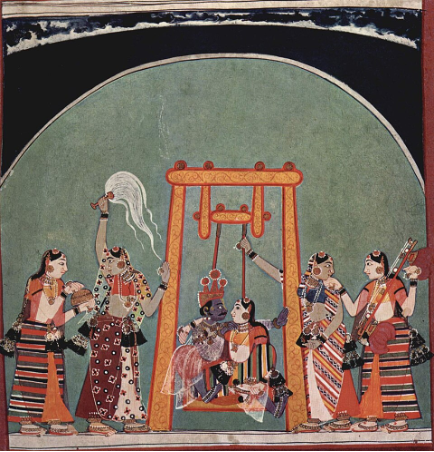
Râgmâlâ-Serie, Szene: Hindola Râgâ from The York Project
Circa 1650.The imagery of Radha and Krishna on a swing is beloved. It has enticed the imaginations of so many. In this ragamala painting based on Raga Hindola, Radha and Krishna are flanked on either side by gopis playing different instruments; but their gaze is only on each other.
Spring is now in full swing; and that means love is too.
The swing represents the culmination of love. A moment for lovers to be together before the seasons change and they are forced apart. The imagery of a swing is often associated with monsoons, a moment of respite from both the summer heat and the circumstances keeping lovers away from each other. Here, in Raag Hindola, the swing, in similar fashion, offers the lovers a moment of togetherness before the summer rains begin. A moment to rejoice in the colours of springtime, before we might bid adieu.
Circa 1981. In Dekha Ek Khwaabfrom Silsila, the eternal lovers Rekha and Amitabh Bachchan bask in the sights of Bollywood’s favourite backdrop: Switzerland. Bachchan stares out into the lush, green mountains, as Rekha walks up to him in a bright yellow chiffon sari. Bachchan tells us with utter surety, far away from doubts, I am sure, that she is in love with me. No longer are we with Akbar, unsure of the feelings of the heart. No longer are we indulging in the initial flutterings that spring brings. We are sure now: this is love.
As Rekha walks up to him, the snow-covered mountains dissolve, suddenly, into a sea of tulips. Red, yellow and white. And there, off in the distance, Bachchan walks in search of his love. He sings dekha ek khwaab toh yeh silsile huwe, door tak nigahon mein hai gul khile hue//I saw a dream and these are the circumstances it showed me. I saw, as far as my eye could see, flowers blooming. He stares across the sea of tulips and finds in the distance Rekha, a flower herself. She runs and embraces him. No longer can there be a doubt that this is love.
The star of this song is neither Bachchan nor Rekha, it is the tulips. While Chopra shows us his beloved snow-capped Swiss Alps, he is quick to drag us back to the abundance of spring he sees in his tulips. He cuts closeups of them to the rhythm of the song, squeezed in between Rekha-Bachchan embraces. In fact, Rekha and Bachchan embrace just as much as Chopra cuts to the flowers. Love and flowers in bloom. There can be nothing more beautiful.
As the song comes to an end, the two lay in a tight embrace amongst a garden of red tulips that snuggle and shake to come close to one another. The breeze blows and they do a little dance; the kind that we see when Bollywood wants to suggest a deeper intimacy. Spring comes to an end, and Bachchan and Rekha too, bring an end to their love story. Just as the tulips dance with one another, they come together, concluding their blossoming romance.
Springtime begins with wonder and possibilities. Once blossomed, the season brings a time to celebrate and fall in love, messy, beautiful, needy, playful love. After all the flowers have blossomed and the springtime sun makes way for a harsher one, love settles into its grooves. A sureness envelops spring. Though the petals fall and the trees shed, the bounty of springtime love remains.

_001.jpg)