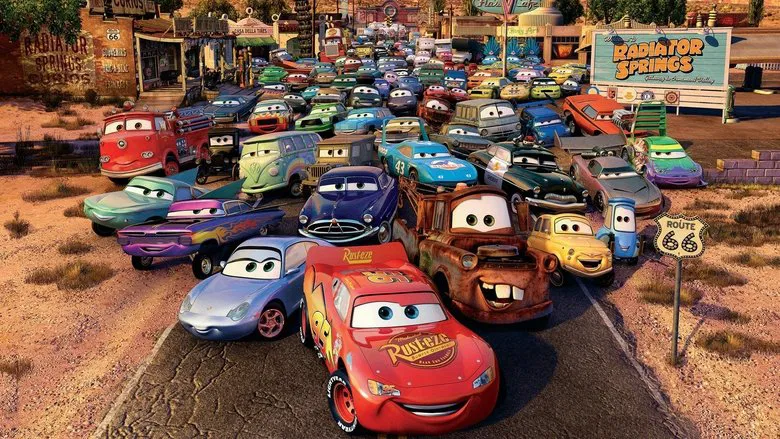
It is a Sunday as I’m writing this. I have a lightning McQueen figurine I bought with my adult money some time ago. The evening sun is setting outside my window, and I have a cute cactus in a pot next to me. It reminds me of the dreary, dusty, fictional desert town of Radiator Springs in the film Cars (2006) – a town stuck in the 80s, lost in both time and the wilderness of the desert. Radiator Springs is culturally significant since it is located somewhere along Route 66. One of the first American Highways, it stretches across the States from Illinois (where I happened to grow up for a bit) to New Mexico and terminating in California.
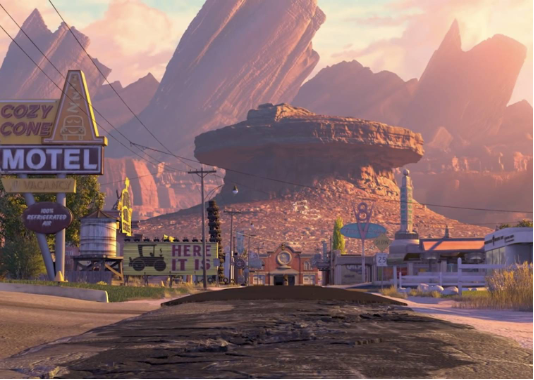
In the real world, Route 66 fuelled westward migration and contributed to the economic prosperity of small communities along its route in the 1930s, until it was removed from the map around 1985 when fast-moving traffic was diverted to the Interstate Highway System. In the movie, McQueen – rookie race car and recent hotshot – who gets lost on his way to a big race and finds himself in the hillbilly hell that is Radiation ki Springs that has been struggling ever since Route 66 was removed from the Map.
The movie begins with a whisper.
“Speed. I am Speed.” The rushing of cars. “One winner. Forty-two losers. I eat losers for breakfast”. Confidence. The inner monologue is a declaration, and he has probably done this before.
And suddenly the silence explodes.
Stadium lights erupt awake. His engine revs. The moment is synced to Sheryl Crow’s Real Gone as the camera pans over a close-up of Lightning McQueen’s beautifully engineered form – his stickers, his exhausts, his glossy paint. The glorious rock and roll of the music is momentarily interrupted by one deafening roar of McQueen’s V8 engine. The screen becomes a blur of movement, logos, colour, and velocity. Commentators roar over one another while cars thunder past at terrifying speeds. The camera practically flies across the track with McQueen, framing him less like a character and more like a force of nature. Even today, rewatching it as an adult, the sequence feels electric. To the five-year-old in me, it was transcendental. Lightning McQueen wasn’t simply cool — he was coolness itself. Confidence distilled into form. He was everything I wanted to be.
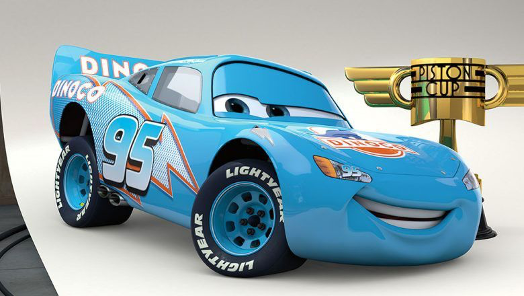
Lightning McQueen’s main motivation in Cars is to get Dinoco’s fancy sponsorship, Dinoco Blue, a fancy blue paintjob which comes with being the Number One racer. He daydreams about it once and has nightmares about it twice across the whole movie. In the opening race of the movie, McQueen speeds ahead of everybody else with total disregard for his team’s advice, refusing to change his tires. It is revealed that McQueen is pretty much a one-man show and fired his crew chief. His tires blow on the final lap results in a three-way tie between the King (Dinoco’s soon-to-retire veteran racer), the embittered and unsportsmanlike Chick Hicks who is McQueen’s rival and foil, and McQueen. It is decided that a three-way tiebreaker will be held in California to decide the winner of the Piston Cup for the 2006 season.
Naturally, desperate to reach California first and secure Dinoco’s sponsorship before anyone else could, McQueen pushes his exhausted trailer driver, Mack, to drive through the night. It is one of the movie’s earliest indications that McQueen sees people primarily in terms of utility. Mack is loyal to him almost to a fault, but loyalty means very little to someone who is terrified of slowing down. Eventually, Mack falls asleep at the wheel, and McQueen is accidentally thrown out onto the highway. In his panicked attempt to return to the Interstate, McQueen tears through Radiator Springs overnight, destroying much of the town’s road in the process.
The next morning, he wakes up not beneath stadium lights or sponsor banners, but in police custody.
Radiator Springs immediately strips McQueen of everything that previously gave him identity. Nobody cares that he is a famous rookie racer. Nobody is impressed by his sponsors or statistics. To the town, he is simply an arrogant outsider who ruined their road and wants to leave as quickly as possible. As the rest of the world panics over McQueen’s disappearance, the disconnected and disjunct Radiator Springs brings him to Kangaroo Court. The “trial” in front of the town residents is pretty comedic on the surface, but thematically important. This is where for perhaps the first time in his life, McQueen is being judged not for his talent, but for his character.
This is also where he meets Doc Hudson — initially presented as nothing more than a grumpy local judge with a sharp tongue and open disdain for McQueen’s ego (and racing background). Their relationship immediately becomes adversarial because they are fundamentally alike. Both are proud, emotionally guarded racers who define themselves through achievement. The difference is that Doc is what happens after the cheering stops. In a gross show of violation of procedural justice, McQueen is sentenced to community service to fix the road, thus cementing him in the town.
Through his attempts at escape, his frictions with the townfolk, and misadventures with Mater the tow truck, McQueen’s time in Radiator Springs gradually slows to the rhythm of fireflies at dusk. He develops feelings for Sally Carrera, a Porsche and former big-city attorney who abandoned her fast-paced life in Los Angeles after realising that success and happiness were not synonymous. Her conversation with McQueen about slowing down is one of the emotional centres of the movie. Sally describes how people used to drive through Radiator Springs instead of merely past them — how the journey itself once mattered. It sounds nostalgic on the surface, but the subtext is devastatingly modern. Everyone is in a hurry, but very few people seem certain about what exactly they’re rushing toward.
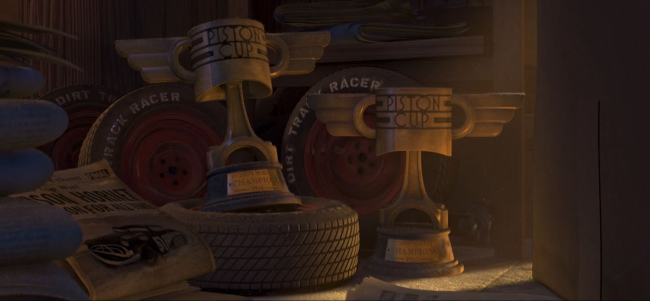
McQueen initially dismisses these ideas because his entire identity is still anchored to the race awaiting him in California. Afraid of losing, especially to Chick Hicks. He has not one but two nightmares to this effect. His clashes with Doc intensify accordingly. Doc sees arrogance and immaturity in McQueen; McQueen sees bitterness and irrelevance in Doc. But the dynamic changes entirely when McQueen accidentally discovers Doc’s secret: three hidden Piston Cups in Doc’s garage. Turns out Doc is secretly the three-time Piston Cup champion and all-time racing legend – the Fabulous Hudson Hornet. Doc is a living embodiment of everything McQueen wanted and a sombre reminder of the hollowness of conquest. Doc reveals that after his big crash, the racing world cruelly turned its back on him, the world that cried his name just as quickly moved on to the next big thing. Though he still remained a racing legend, he was forgotten to history and nobody has seen him in fifty years.
Peace doesn’t last long; the outside world eventually catches up. The arrival of the press in Radiator Springs feels invasive, like modern life barging into a place that had escaped it. McQueen is barraged with floodlights and microphones; and forced to go race in California. At this point in the movie, its pretty clear that he was probably not going to go for his big race. He fell in love with his Hillbilly Hell and its people.
McQueen has a tough time concentrating on the day of his race; his mind flashes back and forth between the track and Radiator Springs. Midway through the race, something inside McQueen finally settles. He’s distracted, overwhelmed, unable to fully sink back into the old rhythm of racing, when suddenly familiar voices cut through the noise. Doc Hudson arrives as crew chief, out of guilt for calling the press on him, stepping out once more as the Fabulous Hudson Hornet. Behind him come the residents of Radiator Springs. Luigi and Guido take over the pit stop while Mater screams himself hoarse from the sidelines. For the first time in the movie, McQueen has people beside him who care whether he wins, not merely the car carrying the sponsors.
You can feel the difference immediately. McQueen loosens up. He starts racing with joy again and he isn’t really racing alone. A part of me watching this scene tells me he’s racing for the love of the game way more than before.
Everything builds toward the final lap and McQueen’s Dinoco Dreams waits at the finish line. McQueen is seconds away from becoming the person he believed he wanted to be since the opening scene of the movie. The music wells and we anticipate McQueen’s deserved victory. Then Chick Hicks deliberately slams into The King. The crash is brutal. The flips over at high speeds over the asphalt and dirt. Twisted metal skids across the track while the entire stadium falls silent. Chick keeps driving.
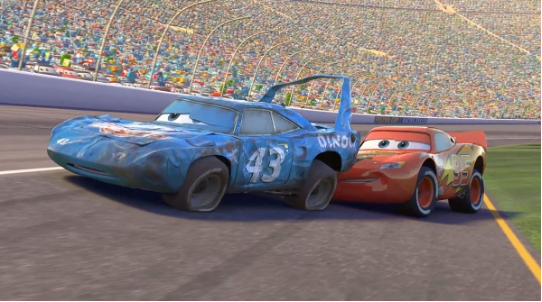
But no, he turns around. The commentators can barely process what they’re seeing as McQueen abandons the finish line and drives back toward the wreckage. Chick Hicks technically wins the Piston Cup, yet the moment feels strangely empty. Doc’s expressions betray him as he wells with pride for the race car he hated. Meanwhile, McQueen gently pushes the injured King across the finish line so he can complete his last race with dignity.
That decision changes the emotional meaning of the entire movie. McQueen finally understands what Radiator Springs had been trying to teach him all along. McQueen is a loser, but he fought with everything and won everyone’s heart. As a kid, I did not understand it. Why couldn’t he have crossed the finish line and then helped the King? I realise now that wouldn’t have had the same meaning. McQueen grew beyond his material desires there and then – as did I growing into an adult. McQueen gets offered the sponsorship anyway, even though he didn’t win. “There’s a whole lot more to racing that just winning.” That’s something I had to relearn in my life as I graduated law school and started my own life in a corporate law firm. I bought that little McQueen figurine – in all blue and Dinoco colours recently. A representation of what I wanted McQueen to be. I was so upset when McQueen rejected the Dinoco sponsorship to stay with the little guys for a bit. We all wanted him to get that epic blue paintjob, basically equivalent to the crown in the racing world. But now, I understand. I always wanted to be like McQueen at the start of the movie; someone who doesn’t know how to stop. The best of the best. And I’d always failed to be “that guy.” Even when I won, my victories felt hollow. But I guess as I grow, I find myself actually becoming a lot like McQueen at the end – I know when to slow down and I know when to pick up pace. People won’t always agree or understand. But that’s alright. Lightning McQueen was still the greatest race car of his generation even without the fancy paint job.
Ten years down the line, in 2017, McQueen completed his last race and retired as a 7-time Piston Cup Champion, forever cemented as a “precision instrument of speed and aerodynamics.” The greatest racer of his generation. He takes up Dinoco’s sponsorship only as an ex-racer. Prestige does not dictate who you are. McQueen set out to win but became the world’s favourite loser. I gave up on myself somewhere in the middle and did a lot of things I never really wanted to do deep down. I felt a sharp pain every morning being who I did not want to be. I used to silently grieve the person I was not. But I’m changing that – I’m going to be that guy – like McQueen was, even if it means letting go of things I used to believe mattered.
When I was a kid, I loved Lightning for who he was at the start of the film. I now love him for who he became in the film’s climax. It is funny – all in all, nothing has changed. I’m still like Lightning McQueen.