
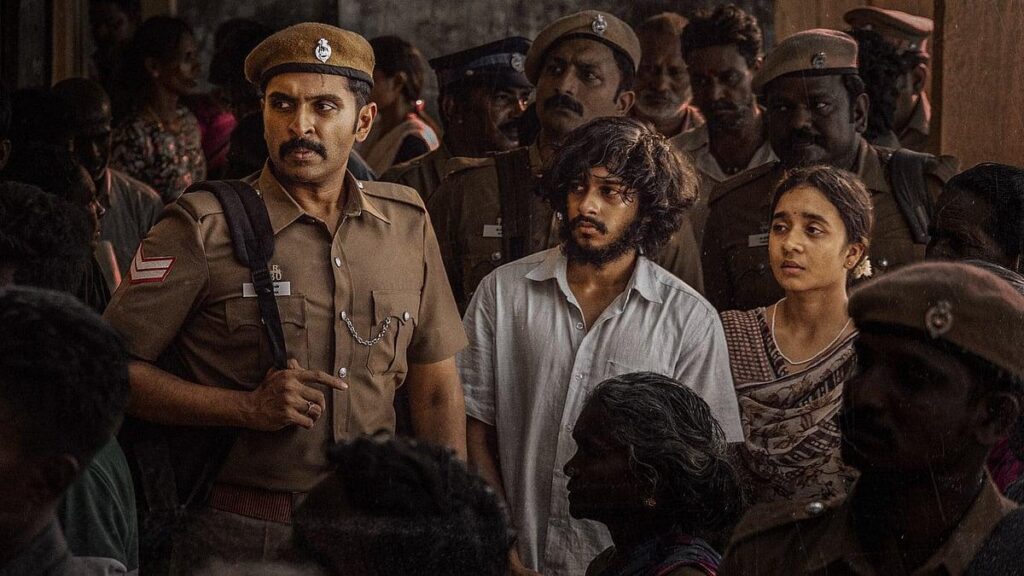
Sirai — prison. The Tamil word arrives before the film does, a single closed syllable followed by a long vowel that opens like a corridor and then stops. Suresh Rajakumari’s debut film (2025), written with Tamizh of Taanakkaran (2022), wears its title the way a warder wears his keys: functionally, and yet with the melancholy knowledge that keys are only ever about doors.
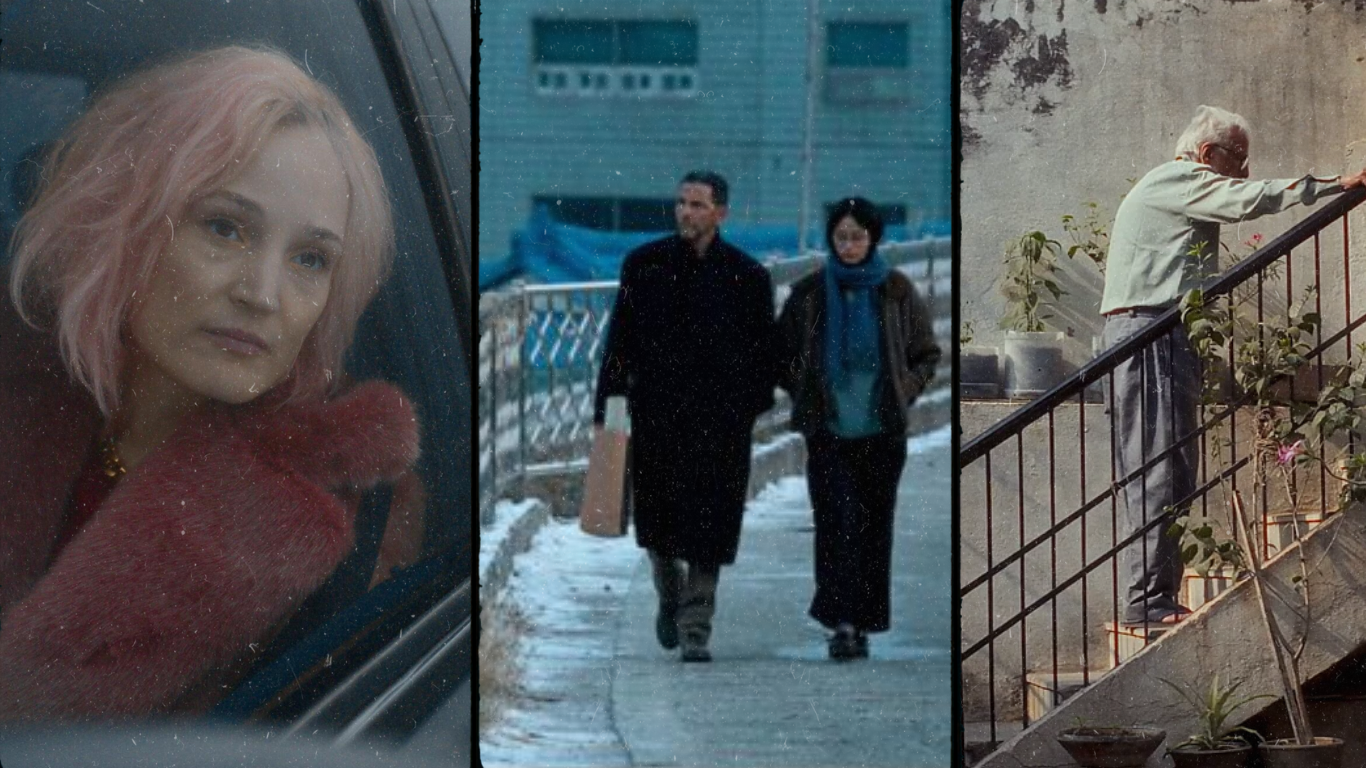
Vellore, 2003. The film inhabits the long moral winter that followed the Coimbatore blasts of 1998—a climate in which the post-blast security architecture, with its aggressive counter-terrorism measures and institutional profiling, settled over the town’s Muslims as an enduring presumption of guilt. In this weather, the everyday machinery of the Tamil Nadu police—the Armed Reserve barracks, the escort bus on its daily rounds—stands as suspicion’s visible architecture: tangible, habitual, impossible to walk past. Kathiravan, the constable played by Vikram Prabhu with a stillness that refuses every convention of the khaki hero, is assigned to escort an under-trial prisoner, Abdul, played by the debutant LK Akshay Kumar, from one jail to another. The narrative is, in its skeleton, a procedural: a man in uniform, a man in chains, a journey between institutions.
But Sirai understands the genre’s ultimate truth: a prison is rarely made of brick and mortar alone. It is the separate glass kept at the tea stall, the invisible line drawn across a village square, and the prejudice that outruns the paperwork. It is the quiet verdict passed by a stranger’s eyes before a single question is ever asked. The film’s true subject is the portable prison: the one that each of us carries for others, and the one that is built around us before we have spoken a word. Into this iron house, at the film’s tender centre, a song enters. It is called Neelothi, and it is the blue flower that grows through the floor of the cell.
The Escort as Pilgrimage
The escort narrative is one of cinema’s oldest secular pilgrimages: two men bound together by rope and duty, moving through a landscape that tests them. Consider, for instance, Martin Brest’s Midnight Run (1988), where the physical constraint of the handcuffs transforms a routine cross-country extradition into a profound moral journey, forcing an alienated, burnt-out former cop turned bounty hunter and a principled accountant to navigate both a hostile American landscape and their own shared disillusionment with the law. Or consider Lokesh Kanagaraj’s Kaithi (2019), wherein the carceral bond is reimagined as a fraught covenant between a paroled father and a wounded officer; here, the catering truck becomes a mobile sanctuary, hurtling through a nocturnal gauntlet that tests the limits of their fragile, necessity-driven alliance across a lawless Tamil landscape.
Sirai inherits this form and quietly inverts its polarity. We begin inside Kathiravan’s vigilance — his suspicion is our suspicion; the camera watches Abdul the way the state watches him, waiting for the mask to slip. Abdul’s calm passivity, unlike the erratic guilt of a suspect or the defiance of a hardened criminal, is what alarms Kathiravan. He waits for the sudden flare of violence or retaliation that will finally expose the volatile threat hiding beneath the docility.Madhesh Manickam’s cinematography keeps the frame close, procedural, almost custodial in its patience. And then, by increments so fine they feel like weather rather than plot, the film acclimates our gaze. The mask never slips because there is no mask. What slips, instead, is the presumption — ours, and Kathiravan’s — and what is revealed beneath it is a love story.
For Abdul is not the film’s prisoner so much as its lover. Behind the charge sheet is Kalai (Anishma Anilkumar), and behind the transit duty is a romance that the film releases to us the way one releases a held breath: the flashback as parole, judiciously granted by editor Philomin Raj. It is here, at the seam between the carceral present and the amorous past, that Justin Prabhakaran’s song Neelothi blooms — sung by Sooraj Santhosh and Chinmayi Sripada, written evocatively by Sarathi, and carried on strings and choir that swell far beyond the modesty of the rural world the lyrics inhabit. The song is only four and a half minutes long. It is also, I want to argue, the film’s entire argument in miniature.
Naming the Beloved a Flower
Neelothi: the word itself is a caress in the rural Tamil register of the lyric. It imagines the beloved as a blue flower—and the choice of blue is not innocent. Classical Tamil poetics repeatedly associates blue and dark blossoms with the emotional landscapes of love: the kuvaḷai, a blue water lily found in pools and lagoons, appears across Sangam poetry, including in neithal imagery of anxious longing, often comparing the tear-filled, yearning eyes of the heroine to moist, dark blue lily petals. Meanwhile, the sapphire-dark kāyā belongs primarily to the rain-soaked mullai landscape, its bloom explicitly signalling the arrival of the monsoon and the heroine’s period of patient waiting. To call the beloved Neelothi therefore places her, suggestively rather than etymologically, within this broader chromatic tradition in which blue flowers become images of desire, waiting, and longing.
But the lyric does something stranger and more beautiful than allusion. The male voice, drifting through the beloved’s memory, describes himself performing aalaththi—the circling of the flame, that domestic ritual of warding, the small fire moved in arcs around a beloved face to draw away the evil eye. In the same breath, the same voice speaks of dua, of seeking Musa (Moses), revered in both Islamic and biblical traditions, of bowing before God, of a man who lived in darkness until a mumin (believer) showed him the light. Two liturgies, one melodic line. The flame that circles and the palms that open. The song does not translate one faith into the other; it lets them coexist in the same singing voice, the way Abdul and Kalai struggle to exist side by side in a society that has built institutions and customs to keep them apart.
A Duet Across the Divide
This is why the duet form matters. Sooraj Santhosh’s voice arrives like groundwater: raw, unfiltered, a voice with the red dust of the earth still on its sandals. Chinmayi Sripada’s answering lines arrive like river water: clear, composed, wistful. Between them, Justin Prabhakaran builds an arrangement of remarkable ambition for so intimate a lyric — the Budapest String Orchestra beneath a village endearment, Kalyani Nair’s choral textures rising behind a word like neelothi as though the whole world had gathered to witness a love the world itself refuses to sanction. The disproportion is the point. The song orchestrates smallness. It takes the most local possible language of love — dialect, flower-name, household ritual — and gives it the sonic scale of the sacred.
Melodrama theory has long told us that the mode’s deepest work is to make the moral occult audible: to let music say what a desacralized world can no longer say in words. Peter Brooks heard in melodrama the grammar of a post-sacred age; scholars of Tamil cinema have countered, rightly, in consonance with the foundational interventions of Ira Bhaskar and Anupama Kapse, that the Indian melodramatic form never occupied that desacralized ground. Bhaskar argues that, with the traditional sacred still intact, Indian melodrama cannot be Brooks’s compensatory “resacralization”; its expressivity instead runs through the stylised aesthetics of bhava, sacralizing the everyday. Kapse grounds the point historically: melodrama entered Indian cinema through the mythological and the saint film—through frontality and darshan—so that the sacred furnishes melodrama’s founding idiom rather than its absent referent.
This genealogy is not antiquarian. The contemporary film inherits that idiom as grammar—frontality as darshan, suffering as moral revelation—and turns it against the one genuinely post-sacral formation in its world: the security state, whose profiling gaze desacralizes persons into suspects. Melodrama here does not mourn a lost cosmos; it defends a living one—for in our melodrama the sacred never left, it merely changed costume. Neelothi is a small, luminous exhibit in that counter-argument. Its sacredness is doubled, syncretic, domestic: the aarti flame and the whispered dua are not background colour but the very machinery of the love it describes.
When the lyric’s man confesses that he was shut in a dark room until his believer-beloved showed him light, the film’s central metaphor turns inside out. The prison — the sirai of the title — is revealed as the condition of being unloved, unseen, presumed guilty. Light is not release from the cell; it is an unmapped landscape of mutual recognition. It is the sovereign gaze stripped of its historical armour, replaced by the face of the one who looks at you without the presumption. By re-centring the narrative within this luminous interiority, the song effectively parleys with the carceral architecture around it. The track strips the state of its absolute power to define the captive body, suggesting that true emancipation is never merely a matter of legal acquittal or a gate swung wide, but an unyielding, domestic refusal to let institutional suspicion become the horizon of the soul. Light is the face of the one who looks at you without the presumption.
The Dark Room and the Lit Face
Cinema, of course, has its own dark room. Every film is developed in one — the darkness of the theatre, the darkness of the camera’s body, the darkness in which the image is not extinguished but made. Sirai seems to know this about itself. Its most carceral spaces — the lockup, the escort bus at night, the corridor of the station — are also the spaces in which its truest seeing occurs. Kathiravan’s education happens in these dark rooms: it is there, watching Abdul pray, watching him grieve, watching him refuse bitterness, that the constable’s suspicion is slowly exposed to light and gradually develops into recognition.
Neelothi is the emulsion in which this structural development occurs. Placed against the flashback of Abdul and Kalai’s courtship, the song functions less as a romantic interlude than as forensic evidence — the film submits its melody to the viewer the way a defence counsel submits a vital document to the court. Here, the music argues, is the interior landscape of the man you have been systematically trained to watch. Here is his tenderness, his domestic theology, his local flower-name for the woman he loves. The Hindi film song has often been theorised as the repository where Indian cinema stores what its rigid narratives cannot say; in Sirai, the Tamil song becomes the precise space where the nation’s carceral suspicion is answered — not with polemic argument, but with radical intimacy. You cannot listen to a man circle the ritual flame around his beloved’s face and continue to see only a state case number.
Chinmayi’s Water, Sarathi’s Soil
The song’s craft rewards close listening. Sarathi’s lyric is structured as a sustained first-person address to a second-person beloved, relying heavily on present and present-continuous forms: “En neelothi neelothi / Un nenapula laandhuren laandhuren / Naa aalaththi aalaththi / En usurula yendhuren yendhuren” (Weeping and wandering in your memory / Circling you with a protective fire, I am breathing the ache of your life). Nothing is completed; everything is sustained. This is the tense of devotion, and also, poignantly, the tense of imprisonment: the under-trial lives in precisely this grammatical condition, suspended between accusation and verdict, neither convicted nor free. The lyric’s devotional loop and the prisoner’s legal limbo are the same shape. Love and detention share a tense.
Against this suspension, the female voice offers the song’s only future through a direct, intimate vow: “Pakka thuna naanum undu / Nenjin vali aathika / Nendhu kitta saami kitta / Enjaamiya paathuka” (I am by your side to heal the heart’s agony; I pray the gods guard my beloved.) This is a promise of absolute return, an instruction to live with hope, and an image of a beautiful time to come. Chinmayi sings these lines with a tenderness that refuses melodrama’s tremble—reassurance delivered as a plea. And Prabhakaran’s arrangement honours the promise: the fretless bass moving underneath like groundwater, the percussion kept soft as a heartbeat behind a door, the choir entering not to overwhelm but to widen—as if the lovers’ private vow had been seconded by a congregation neither mosque nor temple would fully name.
What the Flower Survives
Sirai released in theatres on Christmas Day, 2025 — a date the film could not have chosen more aptly, a festival of a child born under an empire’s census, to a family that would soon be fleeing state violence. It found its audience, became a success, travelled to the streaming platforms in January, and did what quiet films sometimes do: it grew in the dark, passed hand to hand, recommended in the tone people reserve for things they feel they discovered. And at its close, the film permits its lovers what history so often refuses them. Abdul and Kalai marry. The blue flower is not pressed between the pages of a case file; it is planted.
It would be sentimental to call this a happy ending, and the film is too intelligent for sentimentality. Kathiravan’s final address — his insistence that the marginalised suffer most under systemic rot, his charge to future officers to serve beyond caste and creed — reframes the romance as testimony. The love story is entered into the record. This, finally, is what Neelothi achieves within the architecture of Sirai: it converts a melody into a deposition. Long after the plot’s suspense has resolved, the song remains as the film’s residue — the thing you hum on the way home, which is to say, the thing that has already crossed the prison wall and entered you.
Coda: The Geography of the Unchained
How do we rewrite the architecture of a divided world? Sirai offers no legal triumphs or structural overhauls; it offers a duet instead. In the space between the sharp scent of camphor and the soft breath of a whispered dua, it builds a temporary shelter. This is the song’s true sanctuary: an imagined landscape where the red earth of Sivagangai stretches out to meet the open sea of the neithal coast. It is an ancient geography of longing, older than any boundary stone or police checkpoint, mapped only by the rhythm of two hearts refusing to be estranged.
To look upon the beloved without presumption is to realise that the cage was always an illusion we built for one another. The lockup door may remain heavy, and the khaki uniform may still carry the weight of an unyielding state, but the air inside has already changed. For a melody like ‘Neelothi’ is how love serves its verdict: softly, and past all overturning. It does not wait for a judge’s gavel or a warden’s permission. Like the blue water-lily opening stubbornly against the frost of the darkest season, it simply expands—bursting gently through the floorboards of the iron house, unmaking the prison one blossom at a time. The melody thus operates as a profound social deposition, keeping alive the transformative horizon mapped out by Babasaheb Ambedkar and Periyar, where the radical intimacy of intercaste and interreligious marriage becomes the singular path toward dissolving the prison of a religiously divided and caste-stratified society.
To witness the delicate bloom of the neithal shore breaking through the iron house, listen to the song.
References
Ambedkar, B. R. (2014). Annihilation of caste: The annotated critical edition (S. Anand, Ed.). Verso. (Original work published 1936)
- Bhaskar, I. (2018). Expressionist aurality: The stylized aesthetic of bhava in Indian melodrama. In C. Gledhill & L. Williams (Eds.), Melodrama unbound: Across history, media, and national cultures (pp. 253–272). Columbia University Press.
- Bhaskar, I. (2026). Emotional legibility: Modernity, melodrama, and ambivalent gender justice in Bombay cinema, 1930s–1950s. In C. Gledhill, L. Horak, & E. R. Anker (Eds.), Melodrama as provocateur (pp. 272–292). Duke University Press.
- Bhaskar, I., & Allen, R. (2009). Islamicate cultures of Bombay cinema. Tulika Books.
- Brooks, P. (1995). The melodramatic imagination: Balzac, Henry James, melodrama, and the mode of excess. Yale University Press. (Original work published 1976)
- Kapse, A. P. (2009). The moving image: Melodrama and early Indian cinema, 1913–1939 (Publication No. 3410918) [Doctoral dissertation, University of California, Berkeley]. ProQuest Dissertations and Theses Global.
- Ramanujan, A. K. (Ed. & Trans.). (2014). The interior landscape: Classical Tamil love poems. New York Review Books. (Original work published 1967)
- Periyar, E. V. (2024). Collected works of Periyar E.V.R. (K. Veeramani, Ed.; 10th ed.). Periyar Self-Respect Propaganda Institution.




Leave a Reply