When one thinks of Vijay’s older films, one may think of Thulladamanamum Thullum or his breakthrough Poove Unakkaga or Kaadhalukku Mariyadhai. There is a certain lumpishness in these films, not entirely attributable to a novice actor’s insecurity before the camera. He wore loose-fitting polo-shirts and dowdy overalls, hoping perhaps that he will grow into them. There are still remnants of baby fat on his face. Vijay took up characters that were at constant odds with the patriarch, having not yet established his own authority. His uncertainty with himself, a trademark of anyone’s early ‘20s, is concealed by a well-kept mustache that is supposed to give a veneer of dignity. Nobody is fooled.
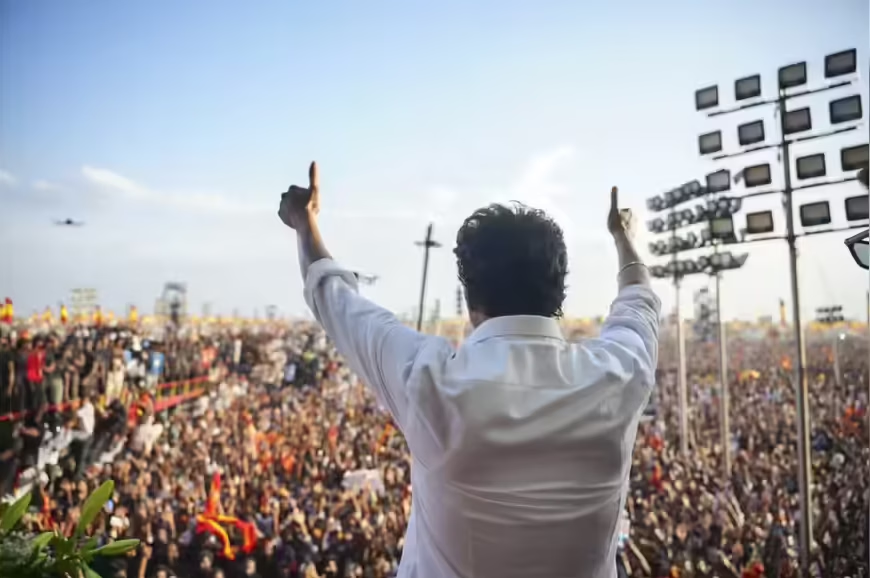
Vijay today is a far cry from any of this. The person we are now most familiar with is a film star in its most extreme form – he has mobilised his cinematic charisma as political capital. The star is of course the subject of immense popularity that edges on worship and devotion, collectivised through fandoms. But the stars have another underrated attribute — the ability to be free. The film stars, like their cosmic counterparts, work fuelled by their own light, freely picking projects, schedules, and remunerations. The freedom is not self-evident or inherent to the status as a star. Much like in Hollywood, Indian cinema production has its origins in the studio system. While the studio system provided the financial wherewithal to fund films, the studios controlled the production and distribution of practically every film. It kept actors, technicians, screenwriters, and directors under a payroll that had the effect of curbing their economic and creative freedom. The immense resources that went into image-creations of actors to turn them into stars came with the caveat of keeping these actors under a tight leash. It was much later that these studio-produced stars were able to work under a number of different production banners and directors, allowing them the liberty to choose the kind of projects they wished to work.
The hard-earned, even precious, liberty that stars were able to wrench away from the studios allowed them to also use movies for their personal self-expression. Tom Cruise, possibly the last Hollywood star alive, uses the Top Gun movies to not simply make hit summer films but to depict his personal tangibility as he loses more and more of himself in Scientology-induced robotism. Closer home, stars constantly use films to interrogate themselves and extricate some mortal anxiety. Mera Naam Joker isRaj Kapoor’s confessional work, telling his own life in three acts, each producing intense, repressed tumult in a man who is not his own but that of the audience he entertains.
The duopoly of superstars that preceded Vijay/Ajith in Tamil cinema do similar work. Rajinikanth, fresh off industry hits like Padayappa, swerves from that direction to make Baba (2002) that signals his turn towards spirituality and disillusionment with the state of politics at the time. The other star, Kamal Haasan was nudged into acting in Nayagan (1988), arguably his piece de resistance, by being aware of his middle-age. One can draw parallels between the moral ambiguity of the character he portrays, faced with the question of “neenga nallavara kettavara” (are you a good or a bad person), and Haasan confronting his own acting career in which masala films increasingly began to dominate in the ‘80s. Haasan’s reckoning with his place in life and quarrels with the world is even more pronounced in the gut-wrenching Mahanadhi (1994), a film that he wrote and acted in with all the “fear, apprehension and paranoia” that haunted a father of two young daughters. More recently, Uttama Villain (2015), an exploration of a dying star with a shambolic personal life is only partially fictional. It is an allegory of both his life and an aging Haasan coming to terms with his morality. As one of the characters says: What kind of a curse is immortality? There is no one at the end of the tale. Victory to death!
We see none of these vulnerabilities, these insecurities in Vijay’s films after the turn of the century. Ghilli (2004) is an earlier film that is perhaps the most emblematic of the shaking off of any fallibility. He is still a young man and the issues with the patriarch remain. But he exudes authoritativeness through physical prowess that marks a shift from his earlier films. For instance, although his father is a high-ranking cop, it is Vijay’s kabaddi-playing character — the son deemed incompetent by the father — that manages to rescue the heroine from the clutches of the villain. In other words, he becomes an alternative, powerful vehicle for justice, outside of the apparatuses of the State. In some of his other, more recent films like Thuppakki, Theri, and Beast, he becomes the State. As Rangan writes in his review of Sura (2009), the films began to function to “define him, in the public gaze, as a candidate worthy of electing into office.” At best, his films come to be populated with a dead wife or a young child that only function to humanise the character so as to not alienate him entirely from the audience; without such emotional props, there is little that distinguishes the protagonists he plays and a psychotic vigilante. In the process, it is only Vijay the Superstar that reigns. The director, the supporting cast, the story, and even the medium of the movie and all its magical potential become marginalised and subservient to the star.
There may be a thousand criticisms of the Mera Naam Joker or the Haasan and Rajini films I referred to. Perhaps they were not well-executed; perhaps the acting was weak. Perhaps there were good reasons why some of them did not attain commercial or critical acclaim. But at their best, these are films where the superstar, for once, ceases to be that. They recognise their own vulnerabilities, their own humane fragility, and submit to the medium of the movies. With such submission, despite the almost auteurist levels of control these stars may otherwise exercise, comes the possibility of films refusing formula and moving in directions unexpected to both the superstar and the audience. It is in such explorations by a superstar cognisant of their freedom and power that the vehicle of the commercial film retains its vitality as a powder-keg that lights up and lifts up the audiences from the genre’s pervasive banality.
To be sure, this is not an indictment of Vijay and his career alone. Several stars from across industries have done the same. It is also not a call against the masala, hero-centric films — even Mera Naam Joker centralises the hero. The case is that in refusing to allow himself and his power to be interrogated through the movies, Vijay and stars like him kill the potential of the medium itself. Like Frankenstein’s monster, the stars feed on the resources, the logics, and fantastical nature of the medium, often it seems, only to turn back and wreck the very thing that created them.