
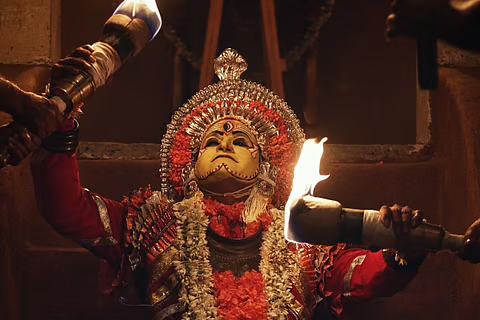
Almost three years ago, I had written about Kantara (2022). At the time, I was a fresh-faced University student and had written about how the State interacts with the specific set of people and their beliefs that made up the narrative crux of Kantara. If I were to be possessed by the ghost of the past me, I would probably write about the fascination of pastoralism or representations of masculinity in Kantara: A Legend Chapter 1 or that land relations are really what most Indian movies are about.
I am less interested in those ideas today. I am more inclined to think and write about what struck me about Kantara when I watched it three years ago. I watched it in a single-screen theatre called Cauvery in Malleshwaram, Bengaluru that has since been shut down. I remember distinctly, a man a few rows ahead of me, getting up as the lights went up at the end of the film, beginning to applaud. He, like so many of us, was clearly overwhelmed. We had no words for what we had just watched.
Southern cinema until very recently has a rich tradition of depicting gods on the screen. Mythological films that narrated the exploits of the gods such as Babruvaahana, Bhakta Prahlada, Karnan, Thiruvilaiyaadal, and Maya Bazaar were a staple in the repertoire of several 20th century superstars in the Kannada, Tamil, and Telugu film industries. Devotional films such as Sri Raghavendrar where faith – often through depictions of the lives of saints and seers – was explicitly sought to be elicited from the audiences were also popular. In recent times, one thinks of Arai En 305-il Kadavul (a remake of Bruce Almighty) and its ambiguous treatment of God or Mookuthi Amman as films that use divinity as a narrative crutch to explore themes that are in fact social (the human protagonist in the latter film is even named after Friedrich Engels and EV Ramaswamy).
Kantara did not sit in either of those categories. The lead actor plays a divine spirit, the daiva, yes, not exactly a god in the terms that we are typically familiar with. But unlike the mythological or devotional films, it is depiction of divinity not through personification but bodily possession. In this, it comes closer to the many Amman films of the 90s and early 2000s. Any viewer of Tamil television on Tuesday or Friday afternoons may be familiar with this genre of films where the goddess possesses the body of a young woman, usually subject to some sort of exploitation or misery, to defeat the antagonist who could be a terrible mother-in-law, a feudal landlord, or a Cinderellaesque stepmother. As noted by others, these movies do not fit within sanitised middle-class rationalities (Selvaraj Velayatham). But an important turn that these films took was the depiction of the goddess return from her fierce form, taken on to slay the antagonist, to a more peaceful, more palatable form, to become shantaswaroopini.
Kantara did none of that. We were forced to reckon with a Panjurli and Guliga only in their form as spirits that possess humans to predict, to assure, and to finally kill. We are never acquainted with the daivas in their more calm forms. The bodies of those who are possessed are inevitably and irreversibly changed, and eventually, they completely vanish. These are not forms of divinity that PVR/INOX regulars are used to.
Kantara was and remains distinct for two other reasons. While the mythological/devotional films of old were wholly and fully committed to epics as epics (much like dance ballads), Kantara fused the holy with other genres of the cinematic like action, drama, and romance. This innovation was what made Kantara deeply exciting when it was first released. It was also, to the best of this author’s knowledge, the first significant movie of this century to delve into mythology and make it big on both big screens and OTT platforms. The last point is important for the point I want to make.
Bodily possessions that the Kantara movies portray are known to several communities in the South. These are highly ritualized events, demanding observation of liturgy by both the ‘performer’ and the ‘spectators.’ As a child, I was prohibited from witnessing a possession, lest I become ‘scared.’ A fear of the possession is really a euphemism for being unable to comprehend its power and its awful beauty. Possessions occur sparingly and only on specific days, and only after due offerings are made to the gods or spirits. The idea is that the gods must will it to be in our midst.
What happens when the possession is repeated again in Kantara: A Legend? What happens when it is replicated over thousands of screens everyday for weeks? Déjà vu struck me when I watching the second film in theatre – it felt oddly violative to watch the climax in both movies with shoes on. And the Kantara movies, in all their splendour, may be in the service of the daiva, but being products of a secular media, they do not have a ritual function. Without giving away too much, Kantara: A Legend does expand our imagination of the forms and powers of the daivas. But this ultimately becomes just that – a cinematic twist and a trope defied. When the daiva is once again the force that wins the battle for the good people of Kantara, it is more than just a predictable plotline that most of us saw coming from a mile away. The daiva is reduced to a character whose powers can be tapped into and then choreographed, captured, edited, colour-graded, and set to a background score to earn an applause in the climax. We then play and replay it on our tiny screens at home, pausing, fast-forwarding, and rewinding it at our will.
At this point, a salutary hat-tip to Walter Benjamin is inevitable. In The Work of Art in the Age of Mechnical Reproduction, Benjamin speaks of the relation between “aura” and cinematic reproduction. Aura is the distinctiveness of a thing, that which sets it apart. Benjamin argues that the media of photography and film, by capturing the art object and reproducing it infinitely, kills the aura. While Benjamin first speaks of this in the context of historical films, I take the liberty to extend it to the specific kind of religious films that the Kantara movies are a part of. For the daiva, the aura would be its specific holiness, a kind of Burkean sublime, invoking simultaneous feelings of awe and terror in those who witness it. It is this aura that a buta kola ‘performance’ seeks to invoke through its ritualised enactment. And it is this aura that loses its vitality through infinite replayings of the film. Cinema, with all its immense creative and imaginative potential, also has a destructive potential. I recognise these are odd, even blasphemous words to write in a film magazine, but these are possibilities that must be reckoned with.
In other, related news, there are 24 films on the Mahabharata currently being developed to create an “immersive experience” through artificial intelligence and virtual reality. The makers plan on creating 100 films by 2029. These are staggering numbers but there seems to be no real thought, at least publicly, about what it means to churn out content through technology and bring experiences to our drawing rooms which were so far confined to quasi-public, religious spaces.
I do not doubt the intentions of Rishab Shetty or the others involved in making the movie. For all of its flaws, both spiritual and technical, the two movies are well-intentioned, sincere, well-madeand largely well-written. Shetty has in fact come out and asked fans to not cosplay as the daiva. But that kind of reproduction through gear and props is an inevitable collateral of rendering the spirits on camera. A third movie is being planned, that is supposed to “explore more secrets of both the well, forest and new deities.” But perhaps the gods are not meant to be acquainted with, perhaps they do not wish to be made familiar. Perhaps the forest and its secrets only desire to be left alone.
Image credit: Still from Kantara (2022).


One response to “Gods on Film”
Well written…no doubt.
Faith always supercedes logic…if daivas did not want the popularity of kantara movie, it wouldnt have succeeded.