“Dancing on the corpses’ ashes
In the company of wolves
Was a stretcher made of cobblestone curfews
The federales performed
Their custodial customs quite well
Dancing on the corpses’ ashes”
– From Invalid Litter Dept by At the Drive In (2001)
It’s become a joke, a rather well-worn one by now, to say that Donald Trump has been getting ideas about fighting the war on drugs from Denis Villeneuve’s film Sicario. That film, and its vastly inferior sequel, depicted clandestine paramilitary operations that go beyond usual police measures used by the US government agencies against the Mexican drug cartels in the border region. In the real world, the American state has accelerated the para-militarisation of the war against the drug cartels.
Earlier this year, Trump ordered the State Department to declare the Latin American drug cartels as “terrorist organisations.” In August, Trump signed a directive permitting the Pentagon to use military force against those cartels. Mexico is the target most people will have in mind. But it also included Venezuela, Guatemala, and El-Salvador.
Already, the Trump administration has launched multiple attacks on alleged drug running boats off the coast of Venezuela. They’ve justified it by saying the US is in an “non-international armed conflict” with the drug cartels. If you’re plugged in to the right-wing MAGA sympathising podcast sphere, you will hear calls to ‘send the SEALs’ into Mexico to deal with the Mexican cartels.
The use of drone strikes on Mexican soil has also been floated. Kooky elements of the Republican party have even flirted with unilateral US military intervention in Mexico itself. The logic is that going after the cartels with law enforcement is not enough to eliminate the drug trade and stop the supply of Fentanyl into the United States. It needs to bring in military and spy agencies to hunt down the cartels similar to how it went after Al-Qaeda and its affiliates in the global war on terror.
It makes one think that Sicario has almost been treated as a manual and inspiration. This is ironic given that Sicario is a critique of the drug war. But it wouldn’t be the first time a film has been inverted against its original purpose. Films that are ‘anti-war’ have been taken up in ways that glorify war because of how well they portray war (for example: those who’ve watched Jarhead will have seen Apocalypse Now’s infamous Ride of the Valkyries sequence being shown to cheering crowds of US Marine recruits who will soon fight in the Gulf war).
Anyhow, that Sicario is so relevant to current events a decade is a testament to just how well it has aged, how ahead of its time it was, and just what a great film Villeneuve had crafted. A film that employs impeccable visual storytelling, a haunting soundtrack and subtle, yet penetrating performances.
Sicario is a different kind of drug war film to what came before it. A mix of a psychological thriller, a neo-Western and a war film. The drug war films of the 1980s and 1990s – Clear and Present Danger and Sniper – had combat sequences in the Colombian jungle that resembled the combat sequences in Vietnam war films. Sicario’s Northern Mexican desert looked rather like the battle theatres of Afghanistan and Iraq in the Global War on Terror (GWOT). It’s tacticool element recalls Zero Dark Thirty. In particular, the brutal violence beneath the surface, the fuzzy lines between friend and foe and the ambiguity of fighting a war that is ‘endless’ or ‘forever’ in nature.
The film opens with a shot of suburban Arizona, before the distinctive figures of FBI-SWAT personnel enter the shot against the desert backdrop. They move in on a small bungalow, that is actually a safehouse run by the Sonora Cartel; they begin to set a perimeter with a sniper watching over. The contrast between the apparent tranquillity of American suburbia and the armed and heavily armoured figures of law enforcement is striking. Viewers are reminded not to presume that the drug war is something that happens ‘over there’; it is taking place at home too. America is no longer the safe haven it used to represent in the drug war genre; it is a battle ground.
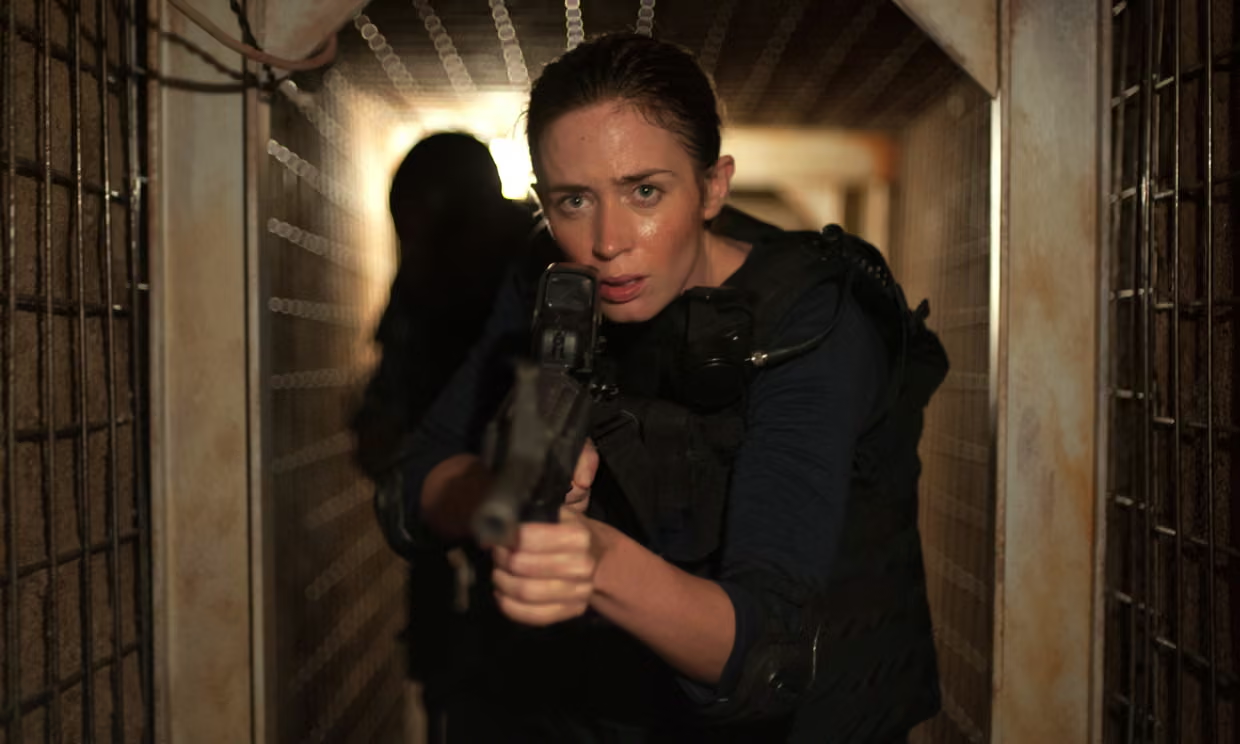
FBI agent Kate Macer (Emily Blunt) is in an armoured vehicle to lead this hostage rescue raid. While clearing the house, they inadvertently make a sinister discovery. Within the walls of this house lay dozens of rotting corpses. After the house is supposedly secured, the team investigate the outdoor shed that is booby trapped, triggering an explosion that kills several officers.
Fuelled by wanting justice for her fallen comrades, Macer is then recruited by a shady Defense Department contractor Matt Graver (Josh Brolin), who is really a CIA spook, to locate the Sonora Cartel members responsible. That he wears flip-flops and a “Visit Cuba” shirt (despite the embargo against an “official” enemy) to a government meeting where everyone else is suited and tied already indicates he is a rogue who isn’t accountable to anyone. She senses there is something dodgy about him, but volunteers herself anyway.
Soon after being recruited into the taskforce, she boards a private jet taking them to an airbase in Texas. There, she meets Alejandro (Benicio Del Toro). Instantly, one can tell he is a haunted character. A ghost who has had his humanity evacuated from him. Not much is revealed about him at first. Later, when pressed by Kate, he reveals that he was once a prosecutor in Juarez, that likely put him in the sights of the cartel. He’s evasive about who he works for now but cryptically says that he was sent from Colombia.
But we later find out that Alejandro is really a lone wolf hell-bent on revenge against the Sonora cartel for atrocities against his family. The deeper Kate finds herself in this covert world, the world of what’s been called the ‘deep state,’ the more she is a fish out of water. This world is one of ceaseless, uneasy ambiguity, where there are no rules and procedures, where you can trust no one. It is the land of wolves. And as her arc shows, she just doesn’t have what it takes to be a wolf among wolves.
Kate is an idealistic servant of the state. That is her tragedy. At the start of the film, she believed the American state were “the good guys.” She is brave, competent, and genuinely wants to make a difference, but only by following the rules and being ethical in one’s duty. In the aftermath of the raid on the safehouse she is asked by a subordinate about what should be said to the US Attorney General about the operation. She replies very simply, and without hesitation, with “the truth.”
But she is the righteous, yet naive cop for a reason. She doesn’t grasp the beast they are dealing with. She storms into the bank to try to go after Manuel Diaz’s money laundering operation because of her naivety. She still thinks like a policewoman who is dealing with ordinary criminals and nearly gets killed because of it. Her righteousness stems from her not grasping the corruption of the cartel; that you cannot fight it with the usual means. Whenever she must grapple with a difficult decision or tries to make her stand against the lawlessness of Graver, there are curiously stars and stripes in the background somewhere. As if this her standing up for “truth, justice and the American way.” At the end of the film, her sense of justice has been broken down and utterly been disillusioned.
In reality, Kate was nothing but a small pawn in a game played at the level of raison d’etat. Her only purpose was to give a sheen of legal legitimacy to Graver’s nefarious activities. That means she is totally disposable. Had she met her end at the border crossing when her assassin hit his shot, she could simply have been replaced by her partner. The meeting at the office where Josh Brolin’s character is evaluating her and Reggie shows this: the CIA is free to pick the most convenient pawn for the situation. It means nothing to them. Through Roger Deakins’ cinematography she is often boxed in, framed through windows, fences, and narrow corridors. This visual language reinforces her lack of agency, how constricted she is in the institution she is operating in. Kate is a sole, puny individual up against vastly more powerful forces than she can battle against.
If Kate is a pawn of the American state, then the pawn par excellence on the Mexican cartels side is Silvio, a corrupt Mexican cop who works for the cartel. His choices start and end within the confines of his own home: go to his kid’s soccer game or sleep in, coffee for breakfast or liquor. If he doesn’t do what the cartel says he dies. At one point he’s literally moved forward as a pawn sacrificed by Alejandro in his move to ultimately get Fausto (the king). Indeed, both Silvio and Kate are used as pawns by Alejandro, who emerges as the victor in this chess game.
There is a version of Sicario that would be a standard Hollywood revenge flick. It would begin with Alejandro’s wife and daughter being brutally murdered by a drug cartel, advance with him striking a deal with the CIA to get him the chance at revenge and then hunting down the cartel boss to bring forth a bittersweet conclusion. Kate Mercer would be a minor character in this tale: the straight-laced, by the book, FBI agent that is an annoying obstacle to the real justice that the anti-hero, Alejandro, deserves, as it is fundamentally his story.
By shifting perspectives from Alejandro (protagonist) to Kate’s (side character), Sicario could tell a deeper story than the Hollywood hokum of a single badass that dishes out good and justice all by himself. Sicario is about a powerless individual ensconced within a powerful institution; a mere cog in a ruthless machine; the dehumanisation of war and the inevitable degradation of morality and the rule of law in war. Kate is an outsider with little power. We expect her to gradually gain power, prove herself, and then take down the cartel jefe herself, as would normally happen, but Kate ends the film as a powerless pawn who is there only for legal reasons.
After the final mission on the border, which was a foil to allow Alejandro to finally enact his revenge plan, and it’s revealed that the American state uses divide and rule between different cartels, Kate asks Graver what does “Medellin” mean. He replies that Medellin refers to a time when there was one dominant cartel that practically monopolised all aspects of the drug trade. In other words, that overdog “provided a measure of order that we could control.” It is here that the brutal truth about the drug war that few people wish to confront appears. As Graver puts it: “until someone finds a way to convince 20% of the population to stop snorting and smoking that shit, order is the best we can hope for.” From the state’s perspective, there is no “winning” the war on drugs, there can only be better or worse ways of managing the problem in the interest of creating a stable balance of power. There are no victors or loses; just survivors.
This is why Sicario can be interpreted in ways that can support the Trumpist hawkishness on the drug war. The “harsh, but necessary” realism of Graver and Alejandro seems sober compared to the idealism of Kate. It is taken as disgusting to see the world through the eyes of the deep state and its lieutenants. But it can give you a certain grip on reality. They’re not evil; just cynical. They operate within institutions, face real problems that can’t be wished away, are always placed in difficult circumstances and have to make decisions on that basis. Peaceniks can sleep easy because they know they’ll never have to confront having to pick the lesser evil, where either way you’ll have blood on your hands, where either way you will be hated, where you won’t get a word of gratitude from anyone.
When you’re up against monsters who have no care for the law, let alone ethics and morality, then you may have to use monstrous methods to combat them. When Graver reveals what the cartels really did to Alejandro’s family, Kate’s facial expression changes from anger to sheer horror, as though the penny dropped. “Yeah, that’s what we’re up against,” Graver reminds her. Everyone deep down knows civilisation needs bad men to protect its walls from even worse men. Only wolves can protect sheep. Cynical, this view on the world is, but it is an attractive and a compelling one to many people. This is the reality under current circumstances. Which means that the circumstances have to be changed. But that is a topic for another day. Until then, Fentanyl will continue to flow upwards into the America, where demand is still strong, and the “iron river” of guns will flow downwards into Mexico and beyond. Managing this problem adequately is the best one can hope for. This is the Land of Wolves after all.
In the epilogue that follows, Villeneuve reminds the viewer that the war is still going on. The young son of the slain Silvio plays football on the outskirts of his local town, with the local community watching on the sidelines (that is revealingly very female). As he’s about to shoot on goal, the piercing salvo of an automatic rifle in the distance bursts their bubble of enjoyment. The children and their parents stop briefly and look in the direction of the gunfire. The game quickly resumes. No matter how much these parents want to protect their children, they can’t shelter them from the reality of the war they are in the middle of. They know what awaits them. Those cubs will either be the next prey of the wolves or will grow up to be the wolves themselves. It was true in 2015. It is still true now.
Image credit: Still from Sicario (2015)