(This article contains spoilers for the film Pulp Fiction and strong language)
Navaneeth M S
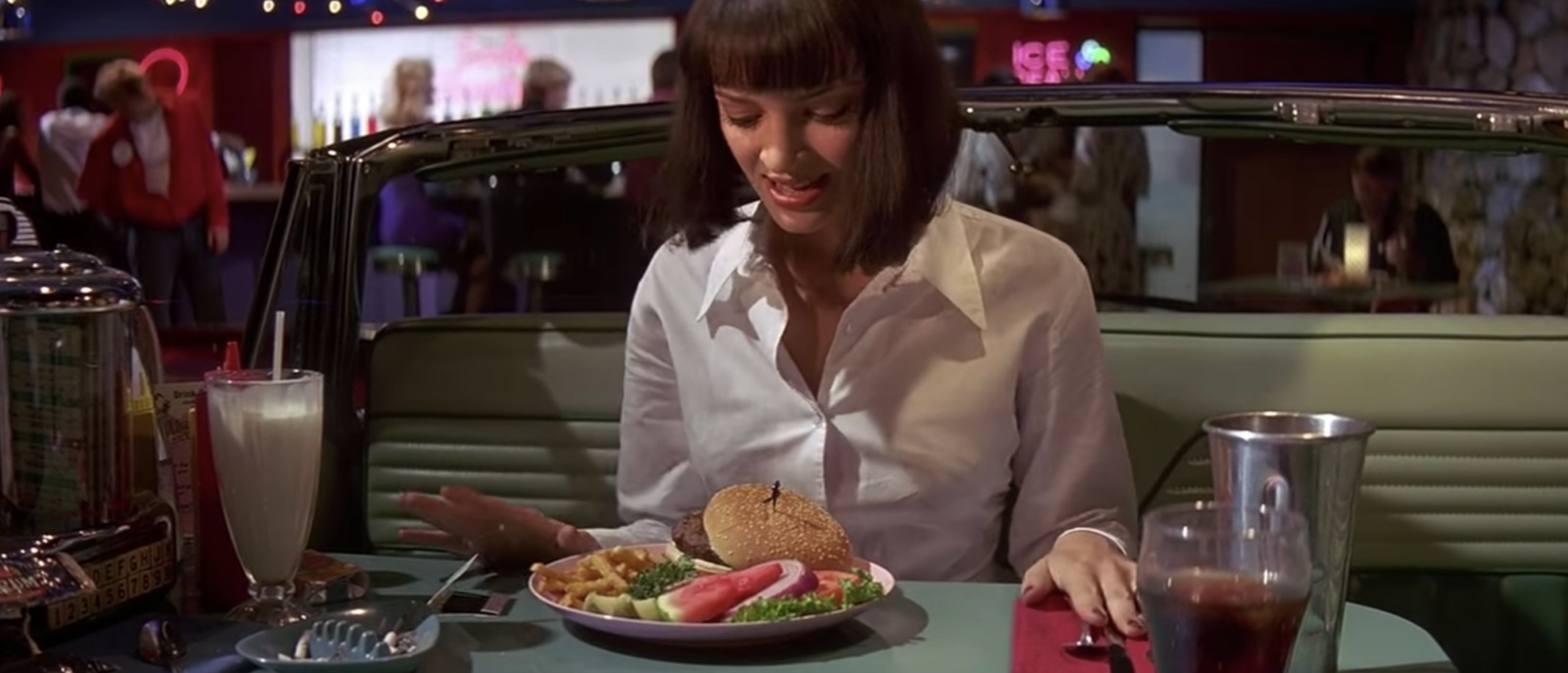
Still from Pulp Fiction (1994)
Quentin Tarantino is often hailed as one of the quintessential filmmakers of postmodernism and his visual references in movies have become a trademark of its own. Tarantino’s movies are not typical ‘food films’. One cannot say food forms an essential part of the plot in his movies like the critically acclaimed Chef (2014), Julie and Julia (2009) which featured several memorable cooking scenes or the Oscar-winning Ratatouille (2007), which made the ‘confit byaldi’ version of the dish popular. Nevertheless, food forms an integral part of his storytelling, be it the setting, the foreshadowing it creates, or the background action it inspires. In this essay, I will be exploring how the director uses visual representations of food as a way to communicate with the audience. I will be focusing exclusively on his 1994 classic Pulp Fiction with a quick glance into similar themes of his other movies namely, Kill Bill (2003) and Inglorious Basterds (2009). This article centers on Pulp Fiction because it offers Tarantino’s most concentrated and influential use of food as visual storytelling, where casual meals become sites of danger, desire, and power. The film’s episodic structure and sustained use of food-related scenes make it especially suited for close analysis. Since food appears throughout Tarantino’s filmography, my aim here is not to catalogue every instance, but to focus on the moments where eating (or not eating) speaks loudest.
Setting the Stage
Food scenes, for most of film history, have been treated as insignificant or, at the most, secondary to the story. There are several practical reasons for this, mainly the cost and inconvenience of having to replace food (often hot) in front of actors – in the same position -when a scene might require multiple takes. They also lacked an ‘aural component’ to enhance humour, drama or exposition and could not catch the audience’s attention like more action-oriented scenes like chase sequences, pratfalls, and acrobatic slapstick comedy that had repetitive success. For these reasons, most directors and cinematographers avoided giving serious attention to food and treated eating scenes with minimal attention. But in most of Tarantino’s film universe, the characters constantly talk about food, order food, prepare food, and each film has at least one memorable food scene. They don’t just consume food to satisfy their hunger, but each food item represents multiple meanings, beyond the inherent consumption value it holds.
Act 1: Breakfast at the Diner
Pulp Fiction opens at a deli that resembles a normal “Denny’s” to the sweet talk of two lovers, Hunny Bunny and Pumpkin. Their sweet, affectionate banter of “I love you, Pumpkin.” and “I love you, Honey Bunny.” contrasts sharply with the explosive chaos that erupts moments later.
Critical studies scholar Rebecca Epstein has noted that Tarantino’s deliberate use of culinary names for these characters, combined with the presence of food in eighty-three of the screenplay’s ninety-three scenes, shows how “food lends depth to characters”. The dietary preferences of these characters also show their cultural and spiritual inclinations. It is observable that Hunny drinks quite a lot of coffee with copious amounts of sugar while Pumpkin is engaged with a pack of cigarettes. This use of stimulants is a foreshadowing for the chaos that is to follow. Their consumption is less about nourishment than about mustering a false sense of courage and strength before staging a destructive robbery in the very space meant for comfort. The scene ends with both of the lovers jumping from their seats with a gun, screaming at their fellow diners:
Pumpkin: Everybody be cool this is a robbery!
Hunny Bunny: Any of you fuckin’ pricks move and I’ll execute every one of you Motherfucking last one of you!
Ironically, Hunny Bunny is the only person who is not cool in this scene. She is high on sugar, has the drowsiness of caffeine, and is crazy, eccentric, and blood-thirsty. The French social scientist Claude Fischler, who has written extensively on food, pleasure, and cultural anxiety, argued that late–twentieth-century Western culture increasingly cast pleasure (especially from sugar/sweetness) as a form of addiction which can be dangerous and out of control. Here, Hunny Bunny’s craze for refined sugar is a kind of a hyperbolic display of this cultural attitude: her unrestrained indulgence in the artificial sweetness fuels an out-of-control, addictive-like state that marks her as dangerous and unhinged. Far from innocent delight, her sweet tooth becomes a marker of psychological unraveling and her tendency for loss of control.
Pumpkin’s casual bigotry is also folded into this same diner ritual that frames the scene. Pumpkin reveals his intolerance towards minorities when he says that robbing liquor shops is less profitable since most of them are owned by Vietnamese or Koreans, and most don’t know English to respond somehow when they ask to empty out their cash registers. He also mentions how it is either Jews or these ‘gooks’ who own such establishments, openly showing his anti-semitic inclinations. This language reflects a broader American habit of “othering,” where foreign cultures are framed as both inferior and threatening. The prejudice resurfaces moments later in a smaller, almost comic gesture: Pumpkin snaps, “Garçon! Coffee!” at the waitress, only to be corrected—“Garçon means boy”—as she refills his cup, neatly underlining his cultural ignorance even as he tries to assert dominance.
Act 2: The Big Kahuna Burger
The audience is then introduced to Vince and Jules, two assassins that work for a gangster, Marsellus Wallace. While on their way to do a hit for Marsellus, Vince is discussing with Jules his recent trip to Amsterdam:
Vince: You know what the funniest thing about Europe is?
Jules: What?
Vince: It’s the little differences…. You know what they call a Quarter Pounder with cheese in Paris?
Jules: They don’t call it a Quarter Pounder with cheese?
Vince: No man, they got the Metric system. …they call it a Royale with Cheese.
Jules: ‘Royale with Cheese’! What do they call a Big Mac?
Vince: ..they call it Le Big Mac… You know what they put on French Fries in Holland instead of ketchup? … Mayonnaise.
This again showcases the American-centric worldview both share, treating U.S. naming and condiments as the default against which foreign variations seem amusing or odd. The repeated emphasis on burgers, coffee, and other fast-food staples reflects a broader cultural fixation on speed, convenience, and consumption. This obsession with fast food therefore extends beyond the dialogue itself and can be understood within the sociological framework of McDonaldization, in which “fast-food restaurants are coming to dominate more and more sectors of American society”. By foregrounding such mundane details, Tarantino not only humanizes the characters but also comments on how deeply American consumer culture permeates everyday life, even the lives of contract killers. The scene becomes an ironic reflection on cultural homogenization, suggesting that global encounters are filtered through the lens of American corporate icons rather than genuine cultural understanding.
Another popular theme that runs across Tarantino’s films is that of dominance. When Vince and Jules pick up the young gangsters who betrayed their boss, Jules comically asks them about their breakfast preference. Then he goes on to take a piece of the Big Kahuna Burger from the seated gangster and gulps it down with a glass of Sprite. This is a raw display of intimidation and dominance as Jules wants to show he’s in control of the situation. The last thing anyone wants to do is to share his hamburger with a stranger and Jules just grabs it from the seated man. A similar premise unravels in Inglorious Basterds (2009) where the SS Colonel Hans Landa uses Apple Strudel as a symbol of tension and intimidation while interrogating Shoshanna, a Jew. It shows how the pleasure vacillates between the victim and the victimizer–the colonel forbids her to consume the strudel until the cream has arrived and later stifles a cigarette in the half-eaten dessert; further showing the different power dynamics. He used the dish to show Shoshanna that he was in control, he could do anything he wanted and there was nothing she could do about it. Here, Landa turns an ordinary pleasure into a means of intimidation, forcing Shoshanna to comply while he controls the pace and outcome of the interrogation.
Act 3: The Path to Redemption
Right before pulling the trigger on the young gangster, Jules quotes his rendition of the Bible – “And I will strike down upon thee with great vengeance and furious anger….My name is the Lord when I lay my vengeance upon thee” (Ezekiel 25:17). This shows the spiritual side of Jules, where he has raised himself to the status of a God, with the power to save lives mercifully. Incidentally, the meal of hamburger and sprite had become the victim’s ‘last supper.’ In the very next scene, Jules survives nearly six gunshots through sheer luck, which he interprets as a message from God and takes as a sign to abandon his life of crime and violence. Ironically, Jules too has then consumed the same piece of hamburger as his last supper as a gangster. When he dines with Vince for breakfast later, we can see he now abstains from pork showing his deep search of his spiritual self, mediated by the Bible. Now, this is the same diner that our Pumpkin and Hunny Bunny have decided to rob, and the group finds themselves in a Mexican stand-off, only to be broken up by Jules. Jules once again quotes the same lines from the Bible but leaves the killer couple alone, for he has moved from being a ‘God’ to a ‘shepherd’ who leads the weak. He also gives the couple some money from his wallet, thus signifying his transformation has been complete Through these recurring fast-food meals, from the violated “last supper” of judgment in the apartment to the abstinent breakfast and the merciful diner resolution, food powerfully underscores Jules’ religious arc. The scenes transform everyday consumption into markers of death, divine intervention, and ultimately redemption.
Women and Food
Although the film presents itself as modern and edgy, its take on gender still relies on old stereotypes, made more entertaining by use of witty dialogue and comical references. As shown earlier, women are shown to be coded with ‘sugar’, showing their hysterical tendencies. Similarly, masculinity is coded through consumption of beef as Vince and Jules see meat as sacred and even the renaming of commercial American hamburgers (The Big Mac) amuses them. Jules also says in the earlier context, to the young gangsters, ‘That is one tasty burger! My girlfriend’s a vegetarian, so I don’t get to eat them very often, but I do love the taste of a good burger’. Hence, he codes women with vegetables or sees them as passive, weak, vegetating creatures while men as carnivorous and active meat-eaters. Mia, the wife of Vince’s Boss Marsellus, is however not stereotyped but is seen as masculine, for she orders meat that is “bloody as hell” for dinner. Again, most of the women in the film are seen as a cause of threat to the characters: Hunny Bunny, Mia, and Fabiane (wife of Butch for whom Marcellus has placed a bounty). The “foodie femme fatale” model is most evident in Mia, who flirts with Vince and later overdoses on drugs, endangering both Vince’s life and his standing with his gangster boss, Marsellus.
Food and Plot lines
Any cinephile can recognise that Tarantino frequently borrows visual and narrative elements from earlier films, using them to create a postmodern patchwork that reshapes, rather than wholly reinvents, familiar genres. The film lacks a single fixed genre, not to mention no one exactly knows who the lead of the movie is. The non-linear character of the film is shown through food and mealtimes. Tarantino links the film’s ending to its beginning through a series of visual and thematic reversals: people eat burgers for breakfast and cereal for dinner; Vince’s drug dealer appears in pyjamas; and Mr. Wolfe shows up in a tuxedo in the morning, explaining that he has come straight from a cocktail party. In essence, all this shows a non-linear plotline to deny predictability. The winning strategy in the fast-food industry was the comfort of predictability, what you order in New York is the same as what you get in London. From even a superficial viewing of Pulp Fiction, one can quickly tell that the movie despises the predictable, and the film stands as a critique of the world of mass consumption.
However, we can see that coffee operates as the film’s spine: In Act 1, Honey Bunny and Pumpkin is having coffee before the robbery; in Act 2, Fabienne talks about coffee and Marsellus carries it (with the doughnuts); and in Act 3, Jimmie serves coffee at his house to Jules and Vince. The film finally closes at the diner where Jules realizes his coffee has grown cold. Because each of these scenes takes place the same morning, coffee, the only food in the film which can be designated to only one time of day, helps to link the plotlines. Coffee also carries multiple meanings, for it shows the class difference between Jules and his friend Jimmy where he refers to the brew as “gourmet shit.” Again, when Mr.Wolfe Shouts at Vince “So Pretty please, with sugar on top, clean the fuckin’ car”, he not only conveys his anger but also shows the essence of the film, that is,. constant shifting between displays of nourishing food and destructive violence. All the food scenes in the movie precede or turn into a violent one.
Conclusion
This ample array of references hidden behind the plates show how many discourses run behind something simple and common as food, which we often take for granted. The proverbial notion that ‘You are what you eat’ is very evident from the food frames for it depicts the character’s prejudices, spiritual beliefs, behaviour patterns and importantly their choices. Just as food connects the film’s scattered storylines, it also reflects a longing for a simpler, more ordinary life. The comfort and normality of diners and restaurants is something the gangsters lack but clearly desire. Again, the constant display of fast food shows the reality of the character’s lives – instantaneous, cheap, delightful, but at the same time disposable.