On Rhythm, Voice, and South India’s Musical Histories
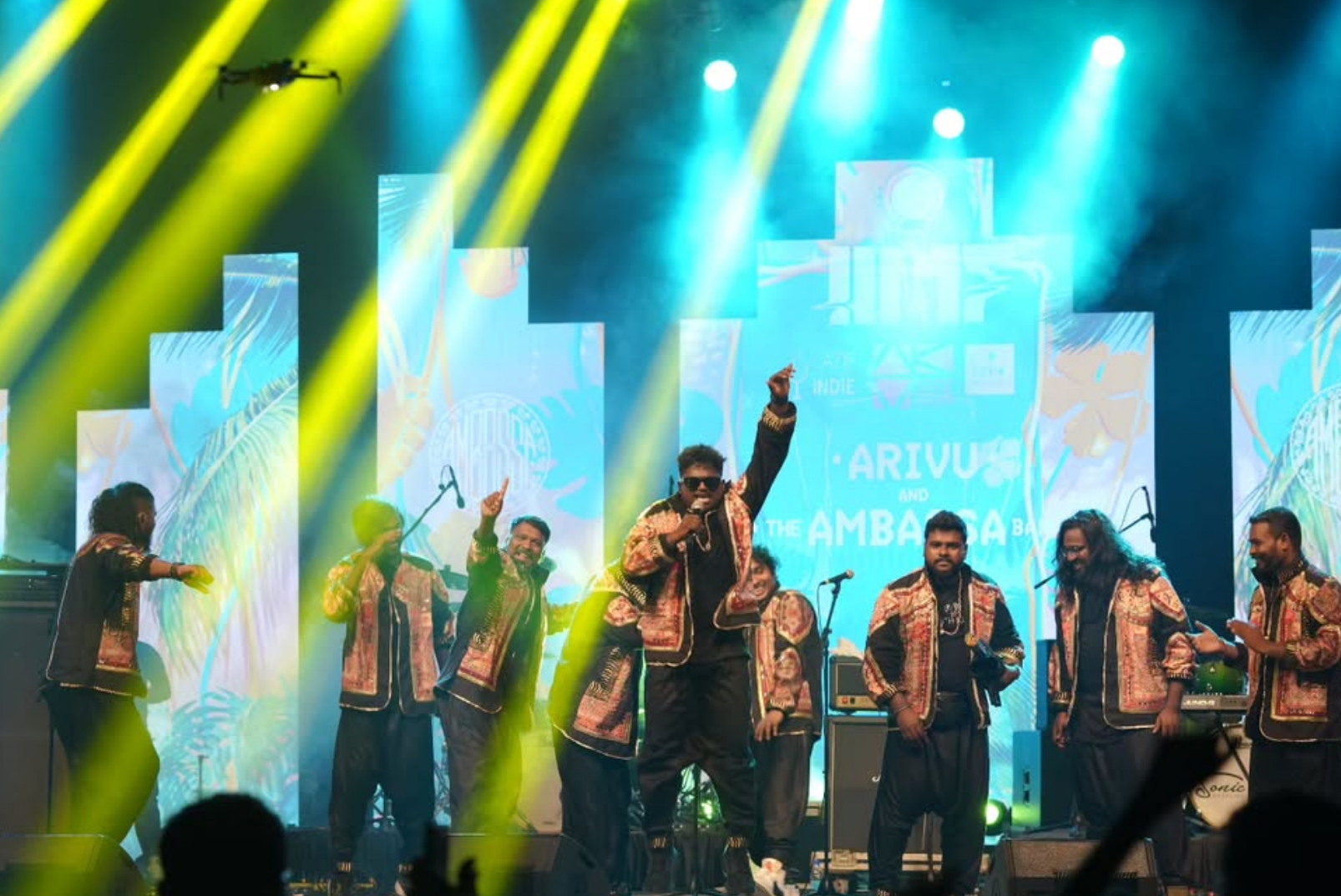
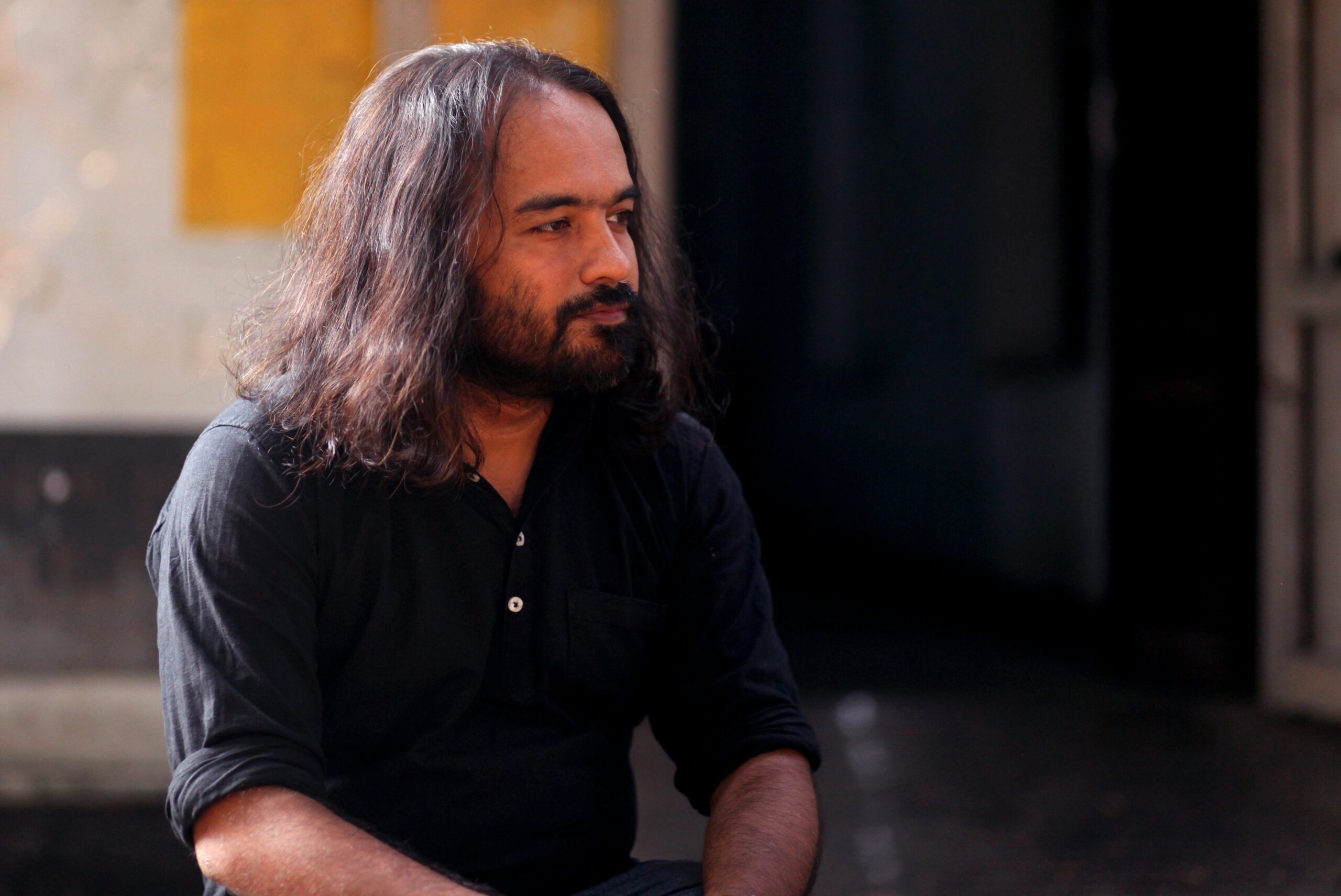
Ambassa performing at the IIMF. Photo via @theambassaband (Instagram); photography by Miltography Productions.
I first paid attention to Tamil rap at South Side Story, the annual concert that hosts several south Indian musicians. In its 2023 and 2024 editions, the festival featured performances by Arivu and the Ambassa band. As a native Malayalam speaker, I could follow fragments of what was being said, but not enough to rely on lyrical meaning alone. What stood out instead was how the music held the audience. Much of it drew on the rhythmic drive of dappankuthu—familiar, repetitive, bodily designed to move people together—but it was being used in a register that felt more than celebratory. The rhythm gathered the crowd, yet it carried a weight that did not dissolve into spectacle or dance alone.
Dappankuthu is usually associated with collective release at weddings, festivals, and film music that turn rhythm into a shared celebration. Hearing it used in a different musical register—sustained rather than episodic, and organised around vocal address rather than quick release—raised a set of questions. How does a rhythm so closely tied to popular enjoyment begin to carry political seriousness? What happens when a sound associated with pleasure begins to bear histories of labour, caste, and social conflict? These questions did not arise from the lyrics alone, but from the way familiar musical instruments were being arranged, sounded and played on stage.
This essay is an attempt to think through those questions by listening closely to sound rather than decoding text. I am interested in how popular rhythmic forms, vocal textures, and performance styles acquire political charge through recontextualization. My focus is not on proving that rap is inherently political, not on treating rhythm as a fixed code of resistance. Instead, I ask how certain musical styles become apparent as serious, confrontational, or political within South India’s longer musical histories. What is at stake, in other words, is how different musical traditions train listeners to hear certain sounds as demanding attention, and others as mere entertainment.
To make sense of this, it helps to recall how musical “seriousness” has been historically and culturally understood in South India. Carnatic music, as an art form, is highly sophisticated and rigorous. Its structures—raga, tala, and improvisational practices such as manodharma—are organised around an aesthetic that treats sound as an object of attentive listening rather than social participation. In the modern kutcheri, music is valued for how systematically raga is developed, the precise negotiation of tala and the disciplined control of voice and tempo. Listening is correspondingly ritualised. Bodily engagement is not absent here, but somewhat regulated with listeners participating through hand gestures—marking tala, subtle physical responses, focused stillness rather than through collective movement.
As musicians and critics such as T.M. Krishna have shown, this aesthetic was consolidated through specific institutional histories. The modern kutcheri emerged alongside social processes that privileged certain communities, venues, and listening practices, while marginalising others. Musical forms embedded in social action—work, ritual, mourning, collective celebration—came to be heard as functional rather than central to art music. Over time, this distinction shaped not only repertoires but habits of listening, producing different expectations of how bodies should relate to sound. What mattered was not simply what music was played, but how listeners were trained to recognise seriousness itself.
Dappankuthu sits squarely within the category of sound that was historically excluded from this regime of “serious” music. Its force is in its social embeddedness, its repetition, volume, and capacity to synchronise bodies rather than invite inward contemplation. In film and popular culture, it often appears as excess—spectacle, release, enjoyment—rarely as something that demands attentive listening. These associations shape how the rhythm is expected to function and what kinds of affect it is permitted to carry.
It is against this background that the use of dappankuthu in Tamil rap becomes legible as more than a stylistic choice. Artists like Arivu do not distance themselves from popular rhythm in order to signal seriousness; they lean into it. This is evident, for instance, in Arivu’s live performances of songs like ‘Namma Stories’ or ‘Annathe Sethi’, where dappankuthu-based rhythms are held across extended verses rather than confined to short celebratory breaks. It is held for longer stretches, paired with sparse instrumentation, and carried primarily by voice rather than melody. The beat remains steady and recognisable, but it is not allowed to resolve quickly into release. Instead, it sits underneath extended verses, repeated phrases, and direct address. What changes here is not the rhythm itself, but the expectation placed on the listener, that dappankuthu is no longer something to pass through quickly, but something asked to sustain attention.
Voice is central to this shift. Carnatic music places enormous emphasis on cultivating a particular vocal ideal—clarity, control, and tonal discipline refined through long training. Tamil rap foregrounds a different set of vocal qualities. Grain, breath, accent, and attack are not smoothed away but allowed to remain audible. This is not simply an aesthetic preference. In a society where speech is socially organised, the sound of a voice carries histories of authority and exclusion. Who gets to speak loudly, whose accent is heard as legitimate, and whose voice is dismissed as noise are political questions that exceed lyrical content.
Arivu’s performances make this difference perceptible in fairly ordinary musical ways. His delivery tends to be direct and tightly paced, with extended stretches of verse carried over a steady rhythmic base. The instrumentation is often minimal, with few melodic elements competing for attention, which keeps the voice clearly in the foreground. Even when the underlying rhythm is familiar and bodily, it is sustained across long passages rather than broken up into moments of release. For a listener like me, with only partial access to the language, this meant that attention was repeatedly drawn to the act of address itself—to the voice, its pacing, and its persistence—rather than to melody or spectacle.
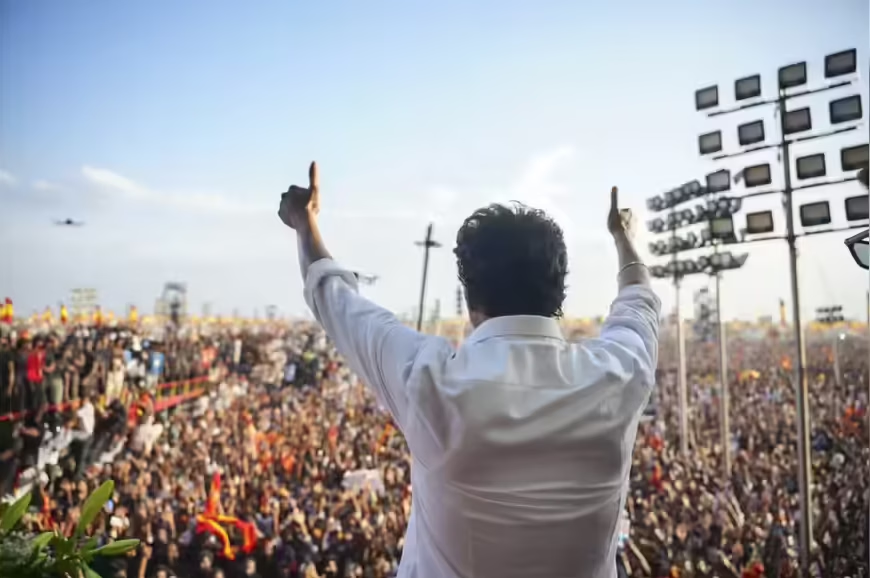
Performance context sharpens this distinction further. The kutcheri is structured around stillness, hierarchy, and a carefully ordered sequence of items. Tamil rap performances operate differently. They are loud, kinetic, and collective. Call-and-response, movement, and crowd energy are integral to how the music works. When Arivu performs songs that explicitly reference social injustice, the audience response is not contemplative but physical. Sound becomes presence. The music does not ask to be listened to quietly; it insists on occupying space.
None of this is to suggest that rap, by virtue of its form, is inherently political, or that the use of dappankuthu automatically produces resistance. Tamil rap, like rap everywhere, spans a wide range—from playful and commercial to introspective and explicitly political. Nor can Carnatic music be reduced to its institutional history alone. My claim is narrower. I am interested in a specific cluster of musical decisions—around rhythm, voice, and performance—that recur in what is now recognised as Tamil political rap, and in how these decisions interact with South India’s longer histories of musical hierarchy.
Listening for politics in this way does not replace translation, context, or political argument. But it does suggest that politics is not only something music says; it is also something music does. When a familiar popular rhythm is asked to carry more than celebration, when a voice refuses refinement, and when sound gathers bodies without resolving into spectacle, history becomes audible. Not as doctrine or slogan, but as pressure—felt, shared, and insisted upon in the present.